CHAPTER ONE cont
2026
We humans are evolution. It is our unique factor. It is the universe that pulls us to the large and sensitive study of energy and human force. Humans now are faced with the mathematics of velocity. Velocity = the displacement of time. The mathematics of Technology is taking us in diversionary ways with velocity, changing the structure of human interconnections.
Re. At a gully that I saw when I was just eleven, just over the valley next to the shepherd's house on Elmshill farm; just old enough to have the skills alone to go and catch and saddle Lucky(my rental pony) I learned that the young shepherd in the late 1950’s killed several of his sheepdogs in a violent temper. Such an image that I walked past and sensed required interpretation. (I mention this with an image some pages ahead)
In my teens and twenties, I decided that enjoyment was to compound thinking and explore experiences.
I took my first flight so as to land on a mountain in the Tasman Glacier in 1967. This was an objective. To stand in deep snow. There I am. My Friend Marja took the photo. (correctives.co.nz/The Future).
As I started writing more deliberately in June 2024, I thought about some current global surfaces in the world news. Twenty-first century is the arrival again of facts of war, due to the actions of current day Russia in advance and Ukraine in defense. New horrors have occurred in the Middle East, the contestants and defenders, Zionist Israel, US and Iran brought to a possible two-week ceasefire in what is now the time of the global world crisis of 2026.
This a weird little fact. At the Venice Biennale (2024) in the Austrian Pavilion, visitors enjoyed ballet rehearsal for Swan Lake by a Ukrainian ballerina, Oksana Serheieva. A review writer at Venice for ARTnews, noticed that a notice on the wall of the exhibition stated that “on Soviet TV, during times of political upheaval, Swan Lake would play on a loop for days in lieu of regular programming’.52 Basically, where we are at, we, the lucky ones observing and reading media about global conflicts, and feeling fresh concerns, is to ask questions about war and peace. By 12/04/2024 the Russian military had increased by 15 % and the conscription age to be thirty years. (general global news) Reporting on World War II, a new History of the Russian Revolution book out from Beevor, has been doing the rounds. It is about the Russian Revolution and the Civil War 1917-1921.53
In my teens and twenties, I decided that enjoyment was to compound thinking and explore experiences.
I took my first flight so as to land on a mountain in the Tasman Glacier in 1967. This was an objective. To stand in deep snow. There I am. My Friend Marja took the photo. (correctives.co.nz/The Future).
As I started writing more deliberately in June 2024, I thought about some current global surfaces in the world news. Twenty-first century is the arrival again of facts of war, due to the actions of current day Russia in advance and Ukraine in defense. New horrors have occurred in the Middle East, the contestants and defenders, Zionist Israel, US and Iran brought to a possible two-week ceasefire in what is now the time of the global world crisis of 2026.
This a weird little fact. At the Venice Biennale (2024) in the Austrian Pavilion, visitors enjoyed ballet rehearsal for Swan Lake by a Ukrainian ballerina, Oksana Serheieva. A review writer at Venice for ARTnews, noticed that a notice on the wall of the exhibition stated that “on Soviet TV, during times of political upheaval, Swan Lake would play on a loop for days in lieu of regular programming’.52 Basically, where we are at, we, the lucky ones observing and reading media about global conflicts, and feeling fresh concerns, is to ask questions about war and peace. By 12/04/2024 the Russian military had increased by 15 % and the conscription age to be thirty years. (general global news) Reporting on World War II, a new History of the Russian Revolution book out from Beevor, has been doing the rounds. It is about the Russian Revolution and the Civil War 1917-1921.53
The next very big political fact is that the Venice Biennale 2026 (the 61st) the Biennale is quite febrile.
Also,1) the Art Trade world is actually looking at some A.I. Art on sale. (Art sales get signposted on Artnet *).2). What was an era more of Art in self-reflection is so much more Art in the now. This year, Koyo Kouoh, the curator of the 61st Venice Biennale, died suddenly in 2025. Her 111 selected artist works exhibit now.Re: KouohIt is of note that Kouoh created an exhibition in 2022. 'It spotlighted a century of work by artists from Africa and the global African Diaspora and was the biggest exploration of Black-self representation and subjectivities to date' (Artnet)
* Artnet is an Art trading platform
REPRESENTATIONS
I am a descendant member of the fourth generation of two English families that migrated to New Zealand in 1839 and '42.
Public service, industry, science, education, invention in the art of agriculture and science is the very foundation of national wealth and of human progress here. This would have been the ethos of the early settlers. In this new era, post the internet, the nation is teaching itself about human, social and sustainable balance. It is also living with the issues of change. The wheels of commerce and power plays run on. For example, we are the progeny that observed the beginning of global trade via containerships. 54
Public service, industry, science, education, invention in the art of agriculture and science is the very foundation of national wealth and of human progress here. This would have been the ethos of the early settlers. In this new era, post the internet, the nation is teaching itself about human, social and sustainable balance. It is also living with the issues of change. The wheels of commerce and power plays run on. For example, we are the progeny that observed the beginning of global trade via containerships. 54
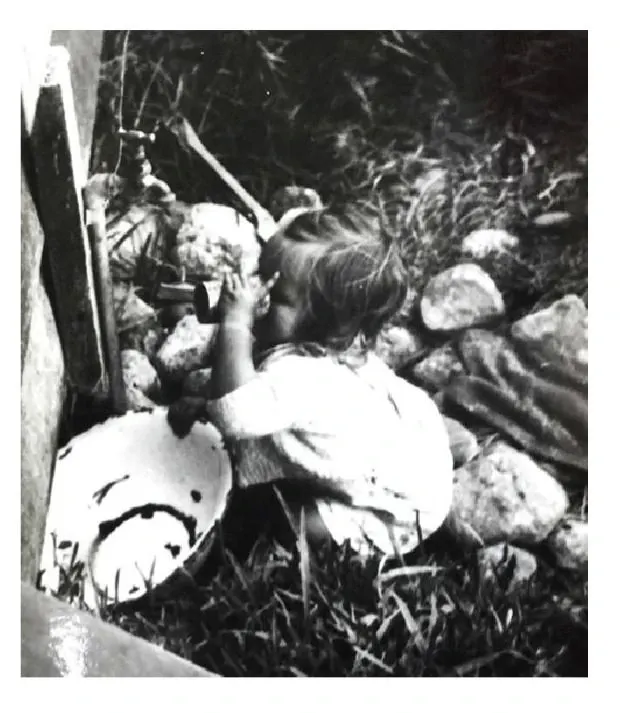
Stephanie, drinking out of the beach water tap.
Photograph by Seth Tiffen. 1950.
The faces of English educated women and men are representations of my genetic groups. British migrant. The first son and three daughter’s marriages were to Britishers. the next children to first second and third generation New Zealand pakeha.
George, great grandmother's dad: doctor
George Monteith, with science and chemistry study in England under his belt before becoming a doctor, worked with scalpel and assisted in early steps in surgery in the 19th Century in Wellington. He arrived in Wellington in 1840, 8th February. * A doctor, Theodor Billroth, was pioneering the use of Chloroform and ether for Anaesthesia in Vienna, ‘the ‘mecca of medicine ‘, at around the same time that Freud was opening an envelope on the human psyche. As to the world of the Apothecary. There is a warm segment in a biography about GOETHE, about such a character type. ' In the life of small town. the apothecary was a person of importance. He was a center for local and outside news, adviser and confidant in many and often delicate situations; people used to meet in the apothecaries for a glass of home-made wine and a chat. Like an alchemist he made his experiments, often in new and untried methods, and was receptive to new ideas; in most cases he was in opposition to the physicians, who were very conscious of their standing.' 55

Excerpt. Oil. by Tennyson Cole. An image fragment of great grandmother, Lucy Tiffen. 1893 (Artist. Tennyson Cole. Appendices)
Tennyson Cole: portraitist *
From the start I liked that the artist Tennyson Cole had asked great grandmother Lucy to make a front on look to him for her commissioned portrait. The custom before this, for portraits, had only every been 'side view'. Literally, this meant that the portraits were of the era before eye contact.
Cole was a visiting artist from Soho, who was in a singing troupe on tour from Hobart to New Zealand. He fitted Lucy in with one or two other Antipodeans, (Governor Grey was one, after having been Prime Minister. He was painted in Australia; John Bllance another. He was a prime minister too). Cole made several paintings in India, Africa, America and then more portraits back in England.
My sleuthing to him was due to the knowledge, from his autobiography of 1931, that his life ambition had been to paint the King. The question was. Why?
*Tennyson Cole. Appendices
signatories to the suffrage petition of 1893

Two emigrant women and one daughter signed the Suffrage petition. One woman, near my great grandmother's age, just five years younger, was a daughter of the first born Tiffen, Charlotte, of our family from Kent. No 427. This was Amelia, raised as Miss Davenport in France with her English parents - her dad, Theodore Davenport, a scholar and teacher in Normandy. 56 She was a widow very young. She came to New Zealand upon invitation by Charlotte's brother, her Uncle Henry Tiffen when she became a destitute young widow to her husband, a merchant/planter on the Gold Coast, Mr Randall. They married in 1869, lived there a short time. Randall died of a fever in Ghana.
444, 445.
The other two signees were Lucy Tiffen, Amelia's in-law Aunt by the time that Lucy married Charlotte and Henry's younger brother, Frederick Tiffen.
Louisa Winifred, daughter of Lucy and Fred Tiffen, signed with her mother on the same day.
OUR PATRIARCH FRED
Great Grandad Frederick Tiffen was the patriarch to all of the first Tiffen New Zealand women and men. He settled and became a farmer in 1860, naming the farmland that he purchased, Elmshill. He bought the land from the Government. It was part of the Waipukurau Block.
The Block was considered the largest land sale that the Government organized to sell to Hawkes Bay European settlers, where Māori had conceded sales in 1855.

Pilocene Geology. Hawkes Bay
Silver Range ending in Hawkes Bay. I quote: Silver Range. ‘Following the line of a series of four fault lines running north-south, known as the Silver Range Fault Zone.’ (online image)
Geology. 57
In 1959, my Nana Irene, widow of Fred Tiffen's youngest son, Frank, and their children, arranged a party to celebrate 100 years of Elmshill.

Official Elmshill Farm Centennial Photograph 1959 The Estate of Frank Tiffen, Frederick and Lucy's last son.
Back Row. Cole Tiffen, Betty Tiffen, Seth Tiffen, Neal Tiffen
Middle Row. Jack Tiffen, Winifred Lysnar, Priscilla Feickert, Anthony Tiffen. Middle. Irene Tiffen
Kneeling back. Jack’s daughter (unknown), Susan Tiffen, Angela Tiffen, David Tiffen.
Front Row, Julia Feickert. Kaye Tiffen. Cynthia Tiffen. Laurie Tiffen. Stephanie Tiffen.
Fred and Lucy's family
Sons
Great Grandad Frederick and Lucy Eleanor Tiffen had married in 1859
It is to be noted that, according to historical events, to look at the males is to document their positions in farming, and in one instance, engineering and then in mid-century war.
The first two sons (William and Frederick, were schooled in Napier (William then in Christchurch) and then moving to farm or try to farm in Tūranganui-a-Kiwa, Poverty Bay) (William stayed. Fred returned).
The third son Henry, schooled in Napier, tried Poverty Bay then returned to farm in Hawkes Bay.
About the 1959 photo. The sons here are sons of George William, Frederick Ansel. Henry Ernest and Frank Louis Tiffen. This was my first experience of meeting sons and their children extended genetically from other than my grandfather Frank and the Bone family. Frank's wife's dad was Henry Hancock Bone. For premeditated reasons the name implied practical strength to me, raising ten children with his wife Ada Fannin. Sure enough, the couple ran the Imperial Cafe in Hastings. It had catering for 80 downstairs, twenty-six upstairs and with a toilet supplied for women. The Bones later took on the country Patangta pub.
Second to back row left, Jack Tiffen, engineer, WWII soldier, Europe, son of George William and Jessie Tiffen. Neil Tiffen, back row right, farmer, soldier WWII, captured in Crete, POW for four years, farmer, son of Henry Ernest and Kate Tiffen. Back row right Frank and Irene's son Seth Tiffen, Home Guard WWII, farmer; back row middle, Fred Ansell and Bertha Tiffen's son Cole, wool classer.
Appendix II PAST FAMILY Tiffen men
FIRST DAUGHTER. MARY ELEANOR.

Mary Eleanor Tuke (née Tiffen) (1862- 1973). c 1929. (Private collection)
This was the first New Zealand born Tiffen daughter, Mary Eleanor, born at Elmshill.
Mary became wife to an Anglican Minister, Charles L. Tuke, in 1883
TUKE-TIFFEN.-On the 18th January, at St John's Church, Napier, by the Rev De Berdt HOVELL assisted by the Rev H Woodford St HILL, the Rev Charles Laurence TUKE, fifth son of the Rev F E TUKE, Rector of Borden, Kent, ( See below) to Mary Eleanor, eldest daughter of F TIFFEN, Esq. of Elms Hill, Hawke's Bay.

Young Mary Eleanor Tiffen (1862 - 1973)
Two Napier Studio photographs. (Private Collection)
One of the most specific facts dads mentioned to me about my geographic locale was when we drove from home to town from the farm each month for supplies (we went monthly). On each good light day after some rain dad would point and say, “Look, Silver Range”, (the coloured photograph above) in Central Hawkes Bay. He made great emphasis about this. The face of a sharp peak of land glistened back to us up off to the east side of the road facing west. It was grey mudstone soil on an upthrust. It was alive when wet in light. Our farm sat just where the last ridge petered out. The land is very new here in New Zealand, geologically.
It appears that the land cover was tussock grasses and fern at the time of the sale of the Waipukurau Block (1851) which included the Silver Range within its northern boundary. Frank and his first two children can be seen in the tussock on a page. Irene and the children too.
It appears that the land cover was tussock grasses and fern at the time of the sale of the Waipukurau Block (1851) which included the Silver Range within its northern boundary. Frank and his first two children can be seen in the tussock on a page. Irene and the children too.
Our Folk History
The children in this family, lived in a thriving farming community accustomed to some intermingling with the Kahungunu Iwi in the region. Mary was four when a Hau Hau force attacked a settler community nine kilometers from Taradale. This was a one-day war skirmish of 1866 (more than thirty Maori and pakeha killed). New Zealand War stories were passed to the family in shorthand i.e that Mary was a little girl when HauHau were nearby and that one day the Tiffen women hid for three days in the bush because they heard an explosion and thought they were being attacked. It transpired, however, that the explosions they heard were their homemade bottles of ginger beer in an outhouse.

Ida Lysnar (née Tiffen) 1866 - 1939
Ida, second Daughter, married Douglas Lysnar in 1893 in Taradale and went to live in Gisborne. Doluglas was the son of a schoolteacher. Ida lived her life in Poverty Bay. (CHAPTER TWO) Winifred, (1901 - 1975) is standing between her younger cousins Jack and Priscilla.
Don't miss the picture of Cole playing in a Hawaiian style music band, a real rage in the 1920's when the steel guitar started. Cole is with his trio on MELODY TWO.

Douglas, Ida and Winifred Frances. 1910. (CHAPTER TWO)
Ida was Fred and Lucy's second daughter.

Early morning swimmer Mission Bay Auckland. The day after my cousin Anne Fenwick's funeral and burial at Purewa cemetery, Auckland, in 2018. Anne links to my mother's side of the family.
Purewa is the cemetery for several of Ida's and her husband's descendant folk.

Dawn. Lake Sorrento. B.C. Canada. 2016 Family inland lake site.
Photograph by Stephanie Beth

Dawn. Pegasus Bay. Canterbury. My homebased coastline. New Zealand

Dawn, Tuki Tuki River. Central Hawkes Bay. 2023.
Photograph by Stephanie Beth.
Son, Tom Robinson. Born 1988. Home.1998.


Tom. visiting at home. 2024.

- Monster doll with no teeth showing. By Stacey Robson. 2026
In the year that I travelled home from Europe in 1974, Winifred Lysnar died in hospital. She was well known in her town, Gisborne. Dad, Eleanor and Aunty Priscilla saw quite a lot of her in their lives. Winifred and then, her older cousin Amelia Randall had both been talked about in the family. The pleasures, practicalities and the stamina of these two women gave me a key. I decided to assert questions about my life and my own actions. Fifty years further on, I became fond of thinking of the effects of
preceding family histories and where history has brought several of us now. Thinking about character and life context has been a mind sharpening arena for me. I started looking into glimmers of intent or aspiration in my people. Their roots.
I settled into some research and writing in 2022. The research required my making visits to museums, home sites and other cousins in the North Island.
The Arts
I was not a formal Art History girl with any focused sense of scrutiny when I was young. I did not wish to interrogate small images in books persistently, for I was an outdoors girl. That scale of looking felt an irritation of limitation so horribly. I had loved being taken to galleries as a child though. There was always the charm of lending libraries.
Every winter holiday our family would go to city galleries all over the country. The sense of being denied real experience with art was enough to set me off to travel, with the determination to get to large galleries. Artists, I deduced, really were something of a mystery. I had my first gallery experiences in Wellington, Wanganui, Christchurch, Dunedin and Auckland. Then, Melbourne, Sydney, Brussels, TATE Britain, the Frick and MOMA, in New York. I saw Guernica, in MOMA, 1972. A big leap. In the 1990s I read Arthur Danto, After the End of Art. Contemporary Art and the Pale of History. It took a while to take in the poetics of the word Pale. His writing presaged fresh styles of thinking and attitudes to change.
I had a huge impact to nerves being in Bangkok for four nights in 1970, when I first started travelling. Passing through there, feeling the atmosphere of a town where active soldiers of the Vietnam War were units taking their week of R&R, a cacophonous world of intense night life, uniforms, abandoned drinking, procuring, noise and wantonness gave me my first shock of imagining what, in dynamics of line, geometry, space and colour, the inspired famous Northern War tableaus were all about. I hadn't yet been to big cities, except for Hong Kong and Singapore, now I was in Thailand. Because of this, besides big art galleries, really, I was being primed for Kubrick cinema.
Art is always made. It is an emblem of culture. What I had realized, though, even after one broad visit to the TATE Britain in 1971, that Art after the era of Warhol really was over vis a vis whether or with what intensity Art would ever again link so closely to emergent histories. The box of disparities and wonder had opened. The TATE held my attention for three Saturdays in a row in 1971. (Turner. ROTHKO, BACON, WARHOL).
Two themes then became a thread for me. Creative expression and Society.
I worked towards an evolution of CHAPTER ONE in writing by setting brief glimpes of family in extension pages alongside.
2025 one day
I leant against the lounge fireplace today, a framed print of a coloured etching that I bought early in 1976, for a moment of thought. It was for a wall in our first flat in the city of Christchurch. I bought some more etchings and prints in town once I decided to take research a little further.
Pavillon d’ Agreement Sur un Etang (1867) (Christies carries one of this Pavillion)The architectural concept is a popular visual trope through French history *
Pavillon d’ Agreement Sur un Etang (1867) (Christies carries one of this Pavillion)The architectural concept is a popular visual trope through French history *
*Château de Fontainebleau: There is a well-known historical building called the Pavillon de l'Étang aux Carpes (Pavilion of the Carp Pond) at the Château de Fontainebleau in France. History: The pond (this one shown here) was created in the Middle Ages and used for extravagant nautical festivals. The half- timbered pavilion was built by Louis Le Vau under Louis XIV in 1662
A weekend visiting Dunedin. 2020

Never too Young to Learn. 2015. Artist Nichola Jackson. Dunedin Art Gallery. 2019Photograph by Stephanie Beth
.jpg@webp "image title")

.jpg@webp "image title")
1994 Sumner Beach
Our Whangarei friends came to David's and my 25th Wedding Anniversary in 1994. Neen Williams and Pat Monro. Photograph by David Robinson.

Tongariro National Park. Holiday with Tom. 1995 Photograph by Tom Robinson.

SYDNEY 2025
Forecourt. Art Gallery of New South Wales. Contemporary Section. Sydney 2025.
Note. Sculpture by Frances Upritchard. (See one Art Bite of mine that precedes my appreciation of Upritchard's sculptural works. In this photo image there is the edge of a commission from the Sydney Modern Project Upritchard received in 2022. Bronzes. Here Comes Everybody.)

Tom and Kate the Cat. 1994
Researching 2023

NZ Rail. East Coast. South Island. 2017

Railway track. Canada. Waterville to Montreal to New York! Photograph by Stephanie 2019

Ruapuna Motorcycle Races. Canterbury. From the left. Robbie McCallum, David Robinson, Maureen Garvie, Robert Garvie. 1976 Photograph by Stephanie Beth 1976
The provisional title for this ebook was Waves, Blood and the Jetstream (2023)
Six(eleven) years ago this week, @LIGO detects first gravitational waves, allowing us to "hear" the sound of two black holes colliding. Astounding achievement. Brian Green Tweet. 2015 58
Imagine Sudbury, Ontario. David and I both went past there on the train in 1972. There we saw our first lunar landscape from the train route from Banff to Toronto to Montreal. At Sudbury already one ecosystem had been eviscerated by the toxins. Today go 2 kilometers underground to the physics Research station SNOWLAB or go to Perimeter Institute in Waterloo. Take it all to equations, on the matter of scale. We’re in the “middle”, Turok said in 2016. * 59 Halfway. 10 to minus five. That’s the middle of space/time complexity. We Humans. Us and earth in the middle of the” limits” to our galaxy. Equations describe the waves: magnetic fields, radio, silence, darkness. All are waves. Simply. Then there is light. It is a particle and a wave.' Take these now as metaphors.
That’s the metaphor. Quantum physics is just an algorithm.
Part one what banged* he aha i pupuhi
Our migrationTo tatou hekePart two
Our educationto maatau matauranga Part two
symmetry and synchronicityhangarite me te hangarite
Our Education Plus, in 2015 the black hole waves - what banged is seen. 2021 hangarite & tukutahitanga we live in a finite universe. (quantum mechanics says so)
Part threeluminosity and reckoningwhakamarama me te tatau
Our migrationTo tatou hekePart two
Our educationto maatau matauranga Part two
symmetry and synchronicityhangarite me te hangarite
Our Education Plus, in 2015 the black hole waves - what banged is seen. 2021 hangarite & tukutahitanga we live in a finite universe. (quantum mechanics says so)
Part threeluminosity and reckoningwhakamarama me te tatau
We are all waves and particles
mehua hangarau, quantum mechanics, e ai ta, says so
he ngaru katoa mtou me nga maturiki
mehua hangarau .
All is waves and then there is light
he ngaru katoa a ka marama ano
Waves are crucial to the understanding of atoms and electromagnetism. Yet there was the paradox. Light always has the same speed. Who would have thought of space and time entities as separate? Then, time and space, Einstein pointed out, depends on the observer. e.g. relativity, i.e. Space and Time are malleable. Then Feynman could point out the expanding universe. Feynman talks excitedly about the universe stretching.
But you must understand number 137. So, there is spin2 (gravity), spin 1 (photons) no spin, (Higgs Boson) half spin (electrons and neutrinos), now for example, the Event Horizon telescope. Or the Laser interferometer gravitational -wave observatory that saw two black holes merging 1.3 billion years ago .We were waiting with bated breath for collisions of protons. Since Higgs established the field, we are stable to the point of 10 to the power of 500 years to maybe the next tunneling, perhaps another Big Bang. *
I First read, In Search of Schrodinger's Cat. John Gribbin with his popular edition about quanta. (1984) Now, since 2015 physicists have seen the bang and we are getting our heads around “quantum gravity”.
We can do something with this perception.
We can do something with this perception.
* Professor Neil Turok asked the question here about the bang. He is now located in Edinburgh in the Higgs Chair of Physics.
.jpg@webp "image title")
Me on an excellent shepherd's horse Pakeha. I was allowed to ride him for half an hour at the end of any of Bob the shepherd's days at work. Elmshill. 1959
.JPG@webp "image title")
Leon Narby. DOP. Stephanie Beth. Director. IN JOY. 1980 60

Event. Christchurch Art Gallery Library in the Phillip Carter Tiffany Thornley remembers. Activism. 50 years on. (1975) 61
A presentation arranged by the curator of Christchurch Art Gallery library. Tim White.
The publisher of Spiral Collective announces that The Bone People. Keri Hulme. 1984. (Booker Prize winner),
is in production of a graphic novel adaptation.Photograph by Stephanie Beth. 2025
THE VISUAL WORLD From where do the prompts come to the artist to create?
Thinking about Art. Talking about Art
In 2018 I decided to write some talks to present at my local Art gallery to keep myself occupied by sensitivities. I had finished producing three independent documentary films. The rumbling of all indications of world change were blatantly on the horizon. Climate disruption had brought in stories of waste, loss, despair. 2018 was only ten years after the 2008 financial crash. Dahr Jamail was just one Arctic ice researcher I read who found different way to live and be in this world. 2019. As well as being an ice researcher, he participated as a soldier in the American War of Invasion in Iraq, a war sometimes described as the Second Gulf War 62
Thinking about Art. Talking about Art
In 2018 I decided to write some talks to present at my local Art gallery to keep myself occupied by sensitivities. I had finished producing three independent documentary films. The rumbling of all indications of world change were blatantly on the horizon. Climate disruption had brought in stories of waste, loss, despair. 2018 was only ten years after the 2008 financial crash. Dahr Jamail was just one Arctic ice researcher I read who found different way to live and be in this world. 2019. As well as being an ice researcher, he participated as a soldier in the American War of Invasion in Iraq, a war sometimes described as the Second Gulf War 62


Jamail wrote another book in 2022
We Are the Middle of Forever
Indigenous Voices from Turtle Island on the Changing Earth
The talks I took on are called Art Bites. Twenty-five minutes solo. I put this decision down to the excitement I felt that I had time to do this; that life had brought me to this form of meditation. To talk about the topic of imagination, people practicing close attention to life, felt like an earnest place to be.
I recalled a parallel of me at eighteen years of age, stepping out to see and feel forms of raw chaos, vigorousness and experimentation by a few artists.
I put Francis Bacon (1909- 1992) in that success camp.

Coast outthrust. Kaikoura after an earthquake of 2016 in 2020. Photographs by Stephanie Beth.63


I saw Bacon paintings of the early to mid ‘60’s in London in 1971. I respected the bull walking off stage at the end of his career in the 1990s. ' the bull alternates between presence and absence ' 64 Bulls carry mana. It hadn’t gone past me, either, that Bacon had been enamored by Picasso. He talked about this in an interview in 1985. 65
I decided to give some talks as a way to foreground what some retrospective thinking about how human life draws gratefully from the Arts at poetic, video and audial levels.
I note some of my wanderings.
GOMA. Gallery of Modern Art. Brisbane. 2023

The Acropolis. Photograph by Stephanie Beth. 2023
Exhibition. ‘Michael Zavros: The Favourite‘ in 1.1 (The Fairfax Gallery) and 1.2 at the Gallery of Modern Art (GOMA)
On holiday in Brisbane in 2023, Australian artist, Michael Zavros wrote a blog. Hyperrealism and a kitsch moment. Acropolis Now. 66 Wall mural and setup for selfies and backgammon play. Zavros described his Acropolis piece as a “kitsch, selfie moment” and “very much about spectacle”. Most unusually, it’s a work that won’t have a life beyond the exhibition, but its transience is part of the appeal for him.* (Sydney Morning Herald) 2023.

*Zavro selected for the Sydney Morning Herald article 2023

I looked at a backgammon table that Zavros had assembled there. GOAMA. 2023

GOMA. Gallery of Modern Art. Brisbane. 'The Favorite' Exhibition.
Bad Dad 2017 was in this exhibition in 2023. Zavros is shown painting finishing strokes. The image was selected for the Sydney Morning Herald article 2023 67
* There were some astonishing works here. Artist, Zavros, had cajoled his own children into participation in his matrix of critique about the downfalls of Narcissism, and more.
MY BIG CITIES

Regent Street. London. Photography one Sunday by Stephanie Beth. 1971
.jpg@webp "image title")
Looking at New York from the 18th Floor of the Drake Hotel. Photograph by Stephanie Beth. 1972

David. We had a suite for four nights , courtesay of staff connections. 1972


Tom and Tom's cat. Kate. Several toys historical. Three made by my mother in the 1950s. Photograph by Stephanie Beth. 1992
Tom's fifth Birthday. 1993


Arts Center roof. Below. Lumiere Cinema at the Arts Center. Christchurch. October 2025.
This area was our apartment space 1982 - 3.
We, David and I, were with a set of six other locals as first tenants in the Art Centre in Christchurch, New Zealand in the early 1980s. We lived there for two years. After the earthquake of 2011 our space was renovated to become the ‘artist in residence’ apartment. The building is still one of our city haunts.

Collage. Dog skeletons. A small grassy gully. Assembled by Stephanie. 2024
I could see my beginnings. I could see what I had decided to do by marrying and travelling. Every extra note of attention I paid to people’s awareness, this recognition of patterning and narrative becomes the overall consideration for Life, Sometime After the Horse was Harnessed. I have enjoyed the use of the camera eye as I have lived.
At eleven years on a walk just over the valley next to the shepherd's house on Elmshill farm catch and saddle Lucky, my rental pony, I was stopped by seeing a cluster of carcasses in the gully down from the house. Such an image required interpretation. I deduced that the young shepherd in the late 1950’s killed several of his sheepdogs in a violent temper. I took in the fact that my dad did not extend his employment past the first contract.
As well as deciding to write Art Bites in the Twenty first century, I started writing these family memoir notes deliberately in June 2023, too. I took first notes as soon as I saw the White sister's gravesite at Bolton Street, and the Monteith site, back in 2001 in Bolton Street, Wellington, that I introduce in my preamble. It was important, for me, that I took a trip to England, America, Canada and Europe in 2001. That trip fuelled my desire to make my third documentary film. I was only a few years away, then, from making a film in America, consequentially. Then, what also became pivotal, was that I believed that I would make time to look into family and the 19th century as a study of fuel, next, as a project after this one, in another decade, in which I might consider times at large, limitations at large, the idea of large monetary global cycles and the arrival again of war. War, yes, then, as 9/11 had happened.
As well as deciding to write Art Bites in the Twenty first century, I started writing these family memoir notes deliberately in June 2023, too. I took first notes as soon as I saw the White sister's gravesite at Bolton Street, and the Monteith site, back in 2001 in Bolton Street, Wellington, that I introduce in my preamble. It was important, for me, that I took a trip to England, America, Canada and Europe in 2001. That trip fuelled my desire to make my third documentary film. I was only a few years away, then, from making a film in America, consequentially. Then, what also became pivotal, was that I believed that I would make time to look into family and the 19th century as a study of fuel, next, as a project after this one, in another decade, in which I might consider times at large, limitations at large, the idea of large monetary global cycles and the arrival again of war. War, yes, then, as 9/11 had happened.
The first Russian that I ever saw was the dancer Nureyev. I saw Fonteyn and Nureyev dancing Swan Lake in London in June 1971. It was a real event to see the famous ballet pair. It was also an electric fact, firstly, that Nureyev was a defector and then, as knowledge came much later, that Fonteyn's husband was a Panamanian revolutionary. (the second feature I only learnt about early 21st Century).
The second man in my recollection was a Russian speaker from Ukraine who sat beside me in a couchette with four others as I entered Paris from Milan in 2001 after my one marvelous Italian holiday I had after attending a film conference in London on Godard. It was a rainy day. A spirit of excitement burst forth as the train approached the city. Everyone started sharing their nibbles and toasting our imminent arrival. This man was a scientist from Kiev, so excited to be in Paris for the first time. He was to attend a science conference. I will not forget this burst of student spirit. Moments later, the festive excitement of arriving in Paris engulfed us all. People in the queue waited patiently for taxi cabs. The gutters rushed with water. There were squeals and laughter as sloshes of water soaked our shoes. No complaining present. Paris still does this to people.
The second man in my recollection was a Russian speaker from Ukraine who sat beside me in a couchette with four others as I entered Paris from Milan in 2001 after my one marvelous Italian holiday I had after attending a film conference in London on Godard. It was a rainy day. A spirit of excitement burst forth as the train approached the city. Everyone started sharing their nibbles and toasting our imminent arrival. This man was a scientist from Kiev, so excited to be in Paris for the first time. He was to attend a science conference. I will not forget this burst of student spirit. Moments later, the festive excitement of arriving in Paris engulfed us all. People in the queue waited patiently for taxi cabs. The gutters rushed with water. There were squeals and laughter as sloshes of water soaked our shoes. No complaining present. Paris still does this to people.
In 1972, David and I journeyed to Mexico. We spent three months there. David had travelled there previously in 1965 and already had acquaintances in the area. At that time, he was very much the guitar-carrying man, his substantial book filled with a collection of folk songs he had written down. Thanks to David’s connections and familiarity, I was introduced into a lively and welcoming scene, and I was embraced warmly by those around us.We spent time with the Frosts, Joan and John. John, an artist and photographer, and his partner, Joan Frost (née Van Every). They welcomed us for days and days of afternoon conversations and outings. Our arrival coincided with the vibrant chaos of an annual festival, where the sky erupted in a cacophony of firecrackers. We navigated the rubble road, entering a sparkling, smoky atmosphere, and were met with a brilliant display of smiles and greetings.
During our stay I had the invaluable opportunity to learn how to print black and white photographs in John Frost ’s studio, a skill that would serve me well in years to come.
Note. Check David's memories of Mexico here or on ALL CONTENT

John O'Shea. Producer and Advertiser and a significant advocate for the New Zealand
Film Commission. John Reid. Director. New Zealand. Online image. c 1960s

My films summary
FILM NO 1.
Right. Still: Joan Lyes in the student documentary that I produced I Want to be Joan (1977) .
This film was all private distribution after a Premiere.
.jpg@webp "image title")
. Above. The image of Joan Lyes, that I manipulated, who spoke in the documentary. This was selected for the cover of Alter Image: feminism and representation in New Zealand art 1973-1993, curated by Christina Barton and Deborah Lawler-Dormer Catalogue at City Gallery, Wellington, by Jan Bieringer, in 1993 for curators. *
Next. Still: Joan Lyes in the documentary I Want to be Joan (1977) Produced and Directed by Stephanie Beth.


Gouache. Untitled. Allie Eagle. 1977 ( Private Collection )


Summer party, Carlton Mill Road 1976. Christchurch.
.JPG@webp "image title")
New home. 29 George Street Rangiora. 1977
.jpg@webp "image title")

you Are WELCOMe to visit rangiora IMAGES VIA ALL content

I commenced being a student at the Film Fine Art School, Canterbury University. 1976.
The 16mm poetic films that Maurice Askew, my teacher showed me in my student years (1975 – 8) were all from mid twentieth century Europe. Night and Fog (1956) by Resnais was my exposure to the holocaust.
Danto's words were an anchoring field of reading to me, reminding me how to ask the questions, not What is Art? But how do we discuss Art? 68 Vis a vis that writer, was I going to spend some time wondering about life’s trajectory right back from the long continental war to within the authorities of absolute power, to new ideas of the State? This historically seemed to be so. What we did in society for three hundred years already, in what we called the study of the Humanities, the short answer has been, ‘Yes’. Bazin, a decade earlier, had things to say about film. Bresson was under Bazin’s watch.
The 16mm poetic films that Maurice Askew, my teacher showed me in my student years (1975 – 8) were all from mid twentieth century Europe. Night and Fog (1956) by Resnais was my exposure to the holocaust.
Danto's words were an anchoring field of reading to me, reminding me how to ask the questions, not What is Art? But how do we discuss Art? 68 Vis a vis that writer, was I going to spend some time wondering about life’s trajectory right back from the long continental war to within the authorities of absolute power, to new ideas of the State? This historically seemed to be so. What we did in society for three hundred years already, in what we called the study of the Humanities, the short answer has been, ‘Yes’. Bazin, a decade earlier, had things to say about film. Bresson was under Bazin’s watch.
SECOND FILM 16mm NEGATIVE

preparing the IN JOY film
My dad was less often a traveler to Auckland, but he did know that his daughters were busy in the Arts, his first daughter, Angela, in Wellington in music with children. Now, me in Auckland city. Here I was spending up large. Thinking about this now, it is strange how I recognize that dad was an investor in that second film. He’d loaned me 10K. He knew that he wasn’t going to get it back. I guess I knew that as well. Celluloid is a seduction. That for dad seemed to whet his curiosity. He visited both cities to see me during those times, in full support. His attendance to my emotional space was a real gift.
It is weird to think that asking for 10K from Dad was just an equivalent of asking for six to a dozen tubes of acrylic paints or oils or chisels from a traditional student point of view to complete an equivalent fourth years of practice. That's what my second film became. There is no doubt that in our twenties, if we have opportunity, we push ourselves to risk and reach. Screening IN JOY In Wellington at the NOW headquarters (National Organization for Women) where I premiered IN JOY in 1981 on a four-screening route, John O’Shea strode down the aisle towards me and grasped my hand. “Congratulations Stephanie! That is the best short film out of New Zealand so far!”
Father arrived a bit late that evening in Wellington city for that screening. All the food had been scoffed! It was a significant Wellington event. There was elation. I was chuffed that dad was present. We had a wonderful night together. It was the only time dad saw something that I made.
Having made my second documentary film quite quickly upon the back of the first, I knew that after the late seventies there would be no ‘on the road’ experience for distribution. I was worn out after the first experience of wandering around the countryside. The culture had shifted, privatized and divided too. Inflation in the 1980s was high. Energy diverted to politicization for many. Hosts who had once been available to me for billets during “Joan” screenings - were often swept up in Anti- apartheid and anti-smelter activities. Camera operators were now hiding footage under beds and secreting it to editors, when possible, for the important documentary of 1980, the protest apartheid during the Springbok rugby Tour of ‘81 (Mita’s Bastion Point: Day 507. 1980, with Gerd Polman and Leon Narbey). I had chosen an expensive post student path. David went to America and Canada during 1980, for the five months whilst I was in a ‘movie role’. He could see his friends and family and keep well away. He returned near the completion of the edit and the Christchurch screening. I screened IN JOY in Christchurch town three days after John Lennon was murdered. There, in America, was a lonely and isolated killer seeking “glory”. The 1980s forged along. A funding body grew its investment money (The New Zealand Film Commission, established 1978). I stopped making films for twenty years after this experience. I was not interested nor suited to enter the commercial or advertising world. Instead, I took up part-time media teaching to young adults. I wanted to be able to ponder life at my private pace. I branched away to stay working discreetly in part-time teaching, enjoy years of cinema as an audience member and shooting video weddings on weekends to keep up the cash flow.
It is weird to think that asking for 10K from Dad was just an equivalent of asking for six to a dozen tubes of acrylic paints or oils or chisels from a traditional student point of view to complete an equivalent fourth years of practice. That's what my second film became. There is no doubt that in our twenties, if we have opportunity, we push ourselves to risk and reach. Screening IN JOY In Wellington at the NOW headquarters (National Organization for Women) where I premiered IN JOY in 1981 on a four-screening route, John O’Shea strode down the aisle towards me and grasped my hand. “Congratulations Stephanie! That is the best short film out of New Zealand so far!”
Father arrived a bit late that evening in Wellington city for that screening. All the food had been scoffed! It was a significant Wellington event. There was elation. I was chuffed that dad was present. We had a wonderful night together. It was the only time dad saw something that I made.
Having made my second documentary film quite quickly upon the back of the first, I knew that after the late seventies there would be no ‘on the road’ experience for distribution. I was worn out after the first experience of wandering around the countryside. The culture had shifted, privatized and divided too. Inflation in the 1980s was high. Energy diverted to politicization for many. Hosts who had once been available to me for billets during “Joan” screenings - were often swept up in Anti- apartheid and anti-smelter activities. Camera operators were now hiding footage under beds and secreting it to editors, when possible, for the important documentary of 1980, the protest apartheid during the Springbok rugby Tour of ‘81 (Mita’s Bastion Point: Day 507. 1980, with Gerd Polman and Leon Narbey). I had chosen an expensive post student path. David went to America and Canada during 1980, for the five months whilst I was in a ‘movie role’. He could see his friends and family and keep well away. He returned near the completion of the edit and the Christchurch screening. I screened IN JOY in Christchurch town three days after John Lennon was murdered. There, in America, was a lonely and isolated killer seeking “glory”. The 1980s forged along. A funding body grew its investment money (The New Zealand Film Commission, established 1978). I stopped making films for twenty years after this experience. I was not interested nor suited to enter the commercial or advertising world. Instead, I took up part-time media teaching to young adults. I wanted to be able to ponder life at my private pace. I branched away to stay working discreetly in part-time teaching, enjoy years of cinema as an audience member and shooting video weddings on weekends to keep up the cash flow.
David and I in 1981 were considering our next move after the peak of life period in a satellite town, Rangiora. That had been a tremendous place with friends for four years. The experience had set the bar high on all forward levels of action. It had been a time of peer group family.
After Rangiora we lived at the Wood Brother Mill. Our TV office inside that we rented out. 1984 -there 1995 We loved living there, leaving what had been the artist Don Peebles’s studio spacious, as is, just putting in bed and a few apple boxes for
furniture. * The majestic space upstairs was two rooms of size with whitewash walls and jarrah timber ceiling beams. We had a commercial timber board as a ‘round table’ tooled up. We renovated an office below. We got in a pair of old steel grey ship’s safe doors from the wrecker’s yard, to cover the windows on the ground floor and built a studio office.
.jpg@webp "image title")
.JPG@webp "image title")
.jpg@webp "image title")
We moved from there to live on the first floor above the restaurant at the Arts Center
(Annie's Restaurant then), after that, we moved up on to the Scarborough Hills for four years in 1983.
.JPG@webp "image title")
David and I visit dad for the summer of 1982. Napier.

Who is Maureen? Who is David? Who is Hudson? Hudson had been David’s friend from Canada since 1961; Maureen, a friend made in 1976. David, he has been my partner since 1969. When Hudson visited New Zealand, he had set himself the task of sailing around the world backwards ie. against the West to East winds. He knew there were ships going to Vladivostok occasionally from here. It was the furthest most Russian Pacific seaport. He waited over five months, got one and then took the train across Siberia to Europe. Hudson was the first multi-lingual “hail fellow well met” friend of David’s that I met. Both Hudson and David were born in Eastern Canada (Quebec) Hud in Montreal where David’s dad and grandparents were from. Hudson could speak many languages. He would have had delirious conversations at the ship captain’s table as he neared the Sea of Japan. In New Zealand while he waited for a ship, he got a job in IT (he was an early IT guy) and he learned how to play cricket. Canadians John and Jill Martland along with their batman Ace Alex Henderson, popped out from Canada. The Martlands were on their honeymoon and Ace just came too. They tramped into the base hut in Mt Aspiring Park in the Matukituki Valley with David’s teachers’ college crew. John was a barrister in Calgary, a tramper and climber in the Rockies and also played bass in a folk band that gained a fine reputation. Ace practiced law in Vancouver, became a Judge there and later became a Judge in the Cayman Islands where he still practices law.
.jpg@webp "image title")
people at risk in forest, particularly those who attended the gambling table. I
didn't do the thinking about aka how Niall Ferguson appraised the ascent of money until I bought his book in 2009. *
We all got up to speed recognizing that the late 20th Century was not shaping in any way like first principle, let alone by revolutionary ideas at the start. Yet, one hundred years later (at the time of this paragraph in 2023) here we are again.
* Ferguson. N. The Ascent of Money. A Financial history of the world. Penguin Press. 2008
.JPG@webp "image title")
Stephanie. 1984.
HUMANITIES
Robert Bresson made The Diary of a Country Priest in 1951. There is an interesting essay in 2006 by Wanda Avila about Bresson’s capacity to explore Transcendent Films. 69 ‘If that film can impress us as a masterpiece and this with an almost physical impact, if it moves the critic and the uncritical alike, it is primarily because of its power to stir the emotions, rather than the intelligence, at their highest level of sensitivity.’ 70 1950 was over seventy years ago. Transcendent experiences continue to be in the cultural frame for many people who appreciate this thematic development. André Bazin had things to say about film. His writing was important early Film theory. He explored the notion of realism of film image. Bresson was under Bazin’s watch, what I could see of his work, were different exemplars to me. Bazin, for example, favoured the long camera take for realism.
I was on peripheral awareness of Bazin, buying his first book. What is Cinema. 1 in 1975.
So much of his early theoretical writing came through before later theoretical academia discussing film. I was intrigued by this European education to which I had not been privy. Neo realist cinema came into film society provision in my university via the significant films so well provided from France and Italy.
Next, I saw Pickpocket. (Bresson. 1959). Then Lancelot du Lac (1974) Then The Bicycle Thief. (de Sica. 1948) Much later, the discovery of de Sica's film Two Women. (1960)
Two Women (Italian: La ciociara [la tʃoˈtʃaːra], roughly translated as "The [Woman] from Ciociaria ") is a 1960 Italian film directed by Vittorio De Sica. It tells the story of a woman trying to protect her young daughter from the horrors of war.
Bresson began to cut in mid shot and close shot in steady unimpassioned edits. He created ideas for audience scope, filming people as models of character abstracts instead of filming acting. 71 “Among the fundamental filmmaking principles advocated for in the book, Bresson argues that "cinematography" (French: le cinématographe) is the highest, even a transcendent, function of cinema. While a conventional movie is in essence "only" filmed theatre that privileges the performances of "actors", cinematography is an attempt to create a new language of moving images and sounds that incorporates what he calls "models" instead of actors. He succinctly defines the difference between the two:HUMAN MODELS: movement from the exterior to the interior...ACTORS: movement from the interior to the exterior.’ (Wiki Notes) 72

Lancelot du Lac. Robert Bresson. 1974
Jocotopec. Mexico. 1972. Photograph by Stephanie Beth

.jpg@webp "image title")
Dad and David. Hawkes Bay. 1982

We lived above Taylors Mistake. Canterbury with a whole view of ocean to Chile. 1983 -1988 . Latitude -43.58199° or 43° 34′ 55″ south

David, Alecia and I. Ocean Beach. San Francisco. 1984 73

Shooting Video weddings, doing research and pregnant. 1984- 1988

Son, Tom Robinson. 9 Otley Street. 1990

Tom. Cheviot. Canterbury. 1997

Niece Amity Tiffen. Akaroa. 1996
2001
I have been able to work a little with the apparatus of moving image culture. I took a flight to London in 2001 to attend a conference at the Tate Modern. This conference was Forever Godard. I bought the complete ECM CD set: Four books written by GODARD. This collection was his 1990s obsession.’ HISTOIRE(S) DU CINEMA. Listening to the discs gave me the idea of what was going on in his head’. Godard intrigued me as the first fanatic of film I had encountered. It was to think about a filmmaker who had started as an experimenter, gained some notoriety and then challenged himself about what to do next. To go to the TATE MODERN and to think about why and how he lived working hard, but reclusively for his last thirty years of life, was interesting. A Sample of Godard text that accompanies Audio editing of Godard’s Histoire:
Chapiter quatre(a)Le contrôle de l’univers,
CD Disc 4ECM New SeriesHISTOIRE(S) DU CINÉMA
Edited sections:any art form is there for the artist to interpret it in his own wayand thus create an emotionliterature can do it by the way the language is usedor the words are put together(9)
The public aren’t aware of what we call montage (11)
Lastly, I think of their silky noise,solitary and quiet, of a fire being consumedas it highlights the whole roomand talking to itselfor talking to mebut almost for itself(36)
the mind is only realwhen it manifests the presencemakes itself manifest orshows its handwhen the word is destroyedwhen it’s no longer a giftmade by one to anotherThat involves something of ‘his’ essenceit’s human friendship that's being destroyed(37)
that miserylast argument last foundation of the modern communityit's the backdrop to all our dramasto our thoughts, to our actionsand even our utopias(38)
true violence is the deed of the mindevery creative act contains a real threatto the man who has dared to perform itThe act is the judge of time(40)
perhaps there are ten thousand peoplewho haven’t forgotten Cezanne’s applebut there must be a billion spectators
who will remember the lighterof the stranger on the trainand the reason why Alfred Hitchcock becamethe only poète maudit to meet with successwas that he was the creator of formsof the twentieth century
and its forms that tell us finallywhat lies at the bottom of thingsnow, what is art if not that through which form becomes styleand what is styleif it isn't the man(43)
only the cinema has seenthat if everyone is doing his jobthe composition looks after itself 45)
there it is nowI’m at your disposalsince I am (48)
in “I think therefore I am” the I of “I am” is no longer the sameas the I of “I think”whybecause it still has to be demonstratedthat there is a relationship between the body and the mindbetween thought and existencethe feeling of existence that I haveis not yet a selfit’s an unconsidered feelingit’s born within mebut without me(49) Jean Luc Godard. 1998 'Cinematic painting'. 74https://en.wikipedia.org/wiki/Histoire(s)_du_cin%C3%A9ma
.jpg@webp "image title")

Toronto to Kelowna over the Rockies. 2019
FEMINISM: two films in the late 1970s
The headspace I am in in 2024 at this point is, ‘self in a world of global complexity, tripping along, reading, noticing and still integrating learning syntaxes.’
In 1977 I was commissioned to look into issues for Feminism. “I Want to be Joan “(1977), was a documentary that I shot during the United Women’s Convention of 1977, in Christchurch). Material revealed how the lack of reform of attitudes and awareness in society was still isolating some women. Barbara’s story was a rebuilding of a personal tale of success. Barbara felt confident that she would reach a moderate middle ground with her partner, who had beaten her once after the couple attended counselling, conversed and shared her life more honestly. Once she knew that he knew that others knew that he had a temper issue, life could be improved. Furthering education for everyone became an answer. (correctives.co.nz/ I Want to be Joan) I remember the 1979 Hamilton Women’s Convention insurrection. The event gave fuel to Māori women to become activists. * I remember watch Donna Awatere and Ripeka Evans in action with a microphone in the outside courtyard disrupting the day structure, no doubt having been fueled by new readings of Leftist literature. * Marti Friedlander arrived in New Zealand as a Jewish migrant from England in 1958. A frank remark of hers about her life here. In 2011 she said “I was so incredibly lonely, and I thought to myself, look around you, Marti. There are other migrants here. They're feeling the same. Why don't you take a biography in photographs of this strange country? And that's how it all began."75 Marti made several photographs at that particular 1979 meet. It is a piece of herstorical gold. I met her over a cup a tea in Auckland, a few days later in Auckland. We passed a moment or two of collegial time. I hitched a ride up to Auckland the day that the 1979 convention collapsed. I was heading there to have a first meeting with Maggie Eyre to put up a sounding board for my 1980 film. Within another two years, Rosemary Seymour, senior lecturer in Sociology at Waikato University, whom I asked to host IN JOY in 1981, gave me assurance that the study of women would be formalized in universities. I quote from the University accolade: 'In 1981, she earned her PhD for her doctoral thesis titled Women at stake: ideological crosscurrents in misogyny and philogyny.
Rosemary Seymour (1919- 1981) was instrumental in helping to establish the Sociology Department at the University of Waikato and the first Women's Studies Department in New Zealand. 76 'Rumbles from workers in the country were happening. One example: at 3.30pm on Saturday December 5, 1981, Ann Waddell and 26 of her colleagues walked out of the Rixon clothing factory in Levin”. 77
The subtlety of IN JOY (1980) lay in its concise approach, presenting a focused exploration through a unique perspective on improvisational drama. (Correctives.co.nz/ Director) Vis a vis employment matters, I wanted to make sure to hire Diane Twiss as sound recordist. At that time, she was a known female industry pioneer in sound recording. Maggie and I did a clown workshop in early 1980 before the film shoot. I joined this too, for four days. It was held in the Limbs Dance studio in Auckland. Maggie, competent, sits down on Queen Street for a workshop ‘twosome.’ That image went into the BETH/ZUSTERS calendar of 1981.
* Allie Eagle. (1949-2022) artist. In 2018, Donna Awatere Huata became a Māori climate change commissioner. “Awatere Huata said she would focus on three main "Pou": representing the interests of landowners, bringing Māori worldview into the climate change discussion, and sharing conversations with indigenous peoples around the world.”
.jpg@webp "image title")

IN JOY film. 1980. Dinner and accommodation provided to all participants for four night and days.(That was dress-up night)

At dinner. From Left. Participant Marilyn Suttcliffe, Maggie Eyre, self. Photograph by Jane Zusters.

This still (Exercise #8 from the last IN JOY workshop shooting day) is not in the film. It is taken seconds after the filmed documentary section wrapped. I title it “Archetype.” The participant from the workshop broke the proscenium arch giving a personal gaze to the still camera. That camera was active as the documenter of the on camera and off camera process of the film being made, with a different goal than the film camera which was only instructed to film the participants in performance. A female out of character from the documentary worskshop exercise, sizes up the stills photographer, confronting the ‘camera eye'. Watch the character progress in the film. 78 correctives.co.nz/IN JOY
What promptings from culture fueled her expression one may ask. (It is of interest to note, also, that a pregnant woman was a participant in the workshops for IN JOY)

Students in prepare to entertain at an old people's home. Their Saturday's performance class teacher Maggie Eyre. Documentary IN JOY (1980)

The last photo I made of Dad laughing with me. Elmshill. 1989.

Tourism at the Colosseum. Rome. Stephanie on holiday Photograph by Stephanie Beth. 2001
.jpg@webp "image title")
*Pig Fern: Home garden: Spring. (Our section had been a cow farm in the 1930’s. The pig fern became the site of our son’s trampoline. Tom jumped for many years. The black gauze above the soil, having provided a microclimate by then, the ferns self-regenerated. This was so pleasurable. Photographs by Stephanie Beth. 1994 and 2024


Christchurch Earthquake. Online images. 2011
David was working on the 18th floor of this building when the Christchurch Earthquake 2011 struck. The building had been his office site for fifteen years. Before this, his office had been down the street at the corner for eight years. which partially collapsed. On the corner, down the road from David's previous 16th floor office (1998 - 2004) victims of the quake succeed in escaping that office by abseiling. The building is now a hotel. I was caught on the third floor of a parking lot that day. As I crawled to the exist, orange dust billowed past the building layers. The orange brick colour was the clue. The Cathedral tower had fallen.

In 2016 I screened US AND THE GAME INDUSTRY at Govett Brewster Art Gallery Cinema, New Plymouth. A class of high school students came.


CIRCUIT film and Video. New Zealand.
Conference collaborators. CIRCUIT and AUT Documentary group.
The Time of the Now. 2018. 78Curator: Erika Balsom.
I was invited to make a short presentation at the conference at AUT in Auckland in 2018 about my first two films. This was a rare, enjoyable occasion. I moved from general obscurity back into art space again. I briefly introduced myself to the conference by mentioning my two early films.I followed up with an essay on the site. https://www.circuit.org.nz/writing-and-podcast/e-book-the-time-of-the-now I popped into the Auckland Art Gallery for a cup of tea on one of the days. I went to the WALTERS PRIZE exhibition for a couple of hours. Walters was the first contemporary artist to integrate indigeneity and the postmodern in vernacular Fine Art in the country. I made sure to go and see the short-listed grouping. It had not yet been announced that Ruth Buchanan had won the prize. Buchanan included a Women’s Art room of print, painting, media and audio cassettes in the basement down from her exhibition as being empathetically and historically in line with her research.
She had lived several years in Berlin. This exhibition originated at Adam Gallery in Wellington, then had been reassembled in Toi O Tāmaki. At Adam she had aligned her interest of study with two German women, Judith Hopf and Marianne Wex in 2016. Her perception with architecture and language provided the country with a very fresh view of let's say... libraries, archives, museums. She made a contention that traditional institutional learning spaces required a review. Her work critiqued space use. I was impressed. A couple of written guidelines stated:
‘From sculpture to architecture, painting to design, performance to audio, manifesto to poetry, Buchanan brings together politics, feminism and the body, arranged in a processual, open and speculative way. It considers competing, overlapping and contradictory modes of representation, both visual and verbal, aural and spatial.’‘BAD VISUAL SYSTEMS is a tour de force of language itself, not so much framed as an efficient means of communication, but as a fantasy of “bad visual systems.”’79I walked past the curtain walls and noted video screens of text at the Toi o Tamaki version. Buchanan would go on to accept a return to New Zealand to be director of Artspace, Auckland in 2022. * Hats off to Buchanan from me when she was asked to describe a favorite Art installation in Auckland, she chose Michael Parekowhai's state house, The Lighthouse, built at 1.1 scale. 80
.jpg@webp "image title")
Hanging curtain. Part of BAD VISUAL SYSTEMS 2017. By Ruth Buchanan. Auckland Art Gallery. Photograph by Stephanie Beth. 2018
*The adjudicator of the prize for Walters was from Brazil, Adriano Pedrosa, the 2018 International judge.
My small specialty with documentary had already become the question of provocative audio. What is said and what is not said, not what is made, painted, sculpted, textured, danced or shown.
I listened to myself speaking about shooting video weddings in 1984
I listened to myself speaking about shooting video weddings in 1984

Stephanie researching at the Auckland Art Gallery basement during the exhibition of Ruth Buchanan BAD VISUAL SYSTEMS. 2018
2023
During my 2023 holiday to Brisbane at QAGOMA, I spent an hour hour looking at Zavros. Then paintings by Ex de Medici who was announced as a mid-career artist: Beautiful Wickedness 81 This artist was a standout. She works with precision. For ten years she was a tattoo artist after painting with oils had affected her health. After this she adapted to watercolour in fine detail. There was an interesting video interview with her about her obsession with violence. The Australian military had commissioned Ex de Medici to do work for the peace keeping force based in the Solomon Islands in 2000 and 2003.

.jpg@webp "image title")
* There were some astonishing works in both exhibitions at Goama. Artist, Zavros, had cajoled his own children into participation in his matrix of critique about the downfalls of Narcissism, and more.

Home. Japonica. Winter Garden. 2024
I decided to make my first 'Art Bite' talk about the Artist Simon Denny (1982 -) in 2019

Simon Denny received the Walters Prize in 2014.
In 2015 he was invited to represent New Zealand at Venice Biennale.
The Installation artist Simon Denny (1982 -) became my first topic in 2019 for an Art Bite talk.Denny in 2012 described himself as a ‘post-contemporary, post internet, post capitalist artist’.
Denny has been right at the edge of the thinking curve for a long time. He was enticed by a New Zealand journalist to return to NZ and engage in a project in 2017. This was since the very high- status response he received the Venice Biennale of 2015. The journalist asked him to make a creative response to Peter Thiel being spotted in New Zealand in 2019. Thiel had become a recent New Zealand citizen. an investment capitalist, his most recent (2003) being Palantir, a U.S. data-based analytics company. I was conscious of him in this year, which was years before Trump signed on for Palantir use. (Trump would be buying stocks up large by 2025, trading differently in 2026) I had been back and forth to America between 2009 and 2011 producing my small documentary (US AND THE GAME INDUSTRY) (correctives.co.nz/Issues one & two). I had witnessed and felt an awareness of USA technology developments, what had been beginning to be named 'The Silicon Valley' effect. I incidentally saw candles burnt for Steve Jobs outside on the grounds beside the glass walls of new Apple shops in L.A. when I was there is October 2011. I understood the thrall of excitements about design and innovation. Buzz about acceleration of computer technologies, engineering systems and their upgrades and App developments, was all in the terrain. Art writer Anthony Byrt (living in Berlin at the same time as Denny) wrote a compelling article about Denny's ideas in his commissioned work that Denny called FOUNDER'S PARADOX. He came to Christchurch to introduce t (2017/2018) after it left the Michell Lett Gallery in Auckland. It was hosted by the Christchurch Art Gallery curator, Lara Strongman. I put my energy to the exhibition with great interest. What Simon Denny decided to look into were two concepts -sovereign individual and the State. (correctives.co.nz/Art bites) Connect to cross references on red links or over at the ALL -CONTENT PAGE
Reminiscing
I projected myself into seeing my great, great grandfather as interested in advances in sciences, medicine. He lived in the days before, to say the least, penicillin or MRI scans. One of his local experiences was to do research into the use of aether in support of resuscitation procedures. That was a topical worry - the dangers surrounding near drowning. He advertised himself as a doctor first and was a coroner before he died. Considering his times, a recent doctor acquaintance here, a few months ago, who was working at the local hospital, working in hospital germs control pointed out to me, ‘doctors then just basically used some old remedies and made a few splints for broken bones’.
George was compelled by curiosity and research. He lived before Oxford or Cambridge formally embraced/integrated notions of learning from ancient medicinal wisdoms in Germany, France and England. He first trained so he could run an Apothecary. He did this near Birmingham in the 1830s. George did his first training as people do now by studying ‘online’ - study as a self-driven initiative, reading current documents and writing meticulous notes. I found it delightful to consider how important the postal service was. When I was at university in the mid 1970’s I paid my fees by riding around on a bike delivering mail for the Post Office. When he awaited medical journals from London or Boston via the Suez, medical texts were carried by boat, by dromedary, then on to Sydney and then finally to New Zealand. 82


Timothy Snyder. Lecturing to Yale Students. Youtube. c 202483
When I was born in 1948 my family structure was intact and materially secure. My self-portrait grows out of reflections upon the optimisms and feelings of life experience and relationships. Growing with some logic and then also with an open mind.
When I was the little girl who learned a little about my ancestors, I felt that I was invited into the opportunity to have ideas with a sense of autonomy and the beginning of a wider contextual awareness. When David and I went travelling, I had time to look, listen and read different societies. I would think. How is everyone coping? I would ask There is surely not an even playing field? A blatant realization was to be of colonial English stock. I was a girl at school caroused with exploratory reading of material supplied by an English teacher affected well by early modernist writing too. Modern writing was an edge. Miriam Heath took the senior (Year 13 equivalent) class of eight girls, two carloads it would have been then, to see James Joyce's 1914 - 1921 (published 1922) Irish ULYSSES in Hastings fifteen months before it was even officially given a segregated screening. (worth reading the reviews - from Ebert to even LIT HUB). 84 We went in my school year of 1965. In 1965 separate matinee screenings for men and women were offered. I left never forgetting the effect of a first-person monologue, knowing so little about Irish nationalism or British Imperialism except the basics. 85 I deduce now that the Hastings cinema business (Royal Cinema Deluxe) would have been a test case theatre before official censorship restrictions were applied that year, for other publics had to wait several more months until 1967. I had not been exposed to The Wasteland (T.S.Eliot) but I had read at my school desk, T.S. Eliot’s Prufrock, the ‘shall I wear my trousers rolled ‘poem. 86 The character in the poem, The Wasteland, was wracked by anxieties. This was the idea I began to gather about adults. Many of the adults before me had at least one war in their ‘real lives'. These create such plummets of the soul. I knew my parents were from the generation that knew people who had suffered war. As to the taught frugality of the war generation, I always noted my father’s practical disciplines: shutting doors to not waste heat, turning off lights, not being a consumer of excess. I was very conscious that the generation before me really had had a restricted time. The English had rationing for years. So too the Europeans. I grew up on available milk, meat, vegetables and playtime. I detached enough to watch and image the adults of the past rising in the thick of it all. I grew to realize that much of human social activity is enjoyed because of its refinements, its institutions and the principles of social exchange. It is no small wonder that cuisine took center stage in the moments that civilizations evolve out of agriculture. Agriculture kept people alive. It gave the scope for daylight time and nighttime events specifically around seasons. Humans cultivate thanks and respect for food energy. During the 1970s influential experiences I needed to hear voices to begin to better comprehend the larger human world. For example, the taxi drivers we hired told us so much about the core sense of sadness in Thai citizenry because of regional war. Bangkok, where we stayed for four days in 1970, was a town for American soldiers on R & R from the Vietnam War. Kabul felt timid with pockets of the desperately hopeful when we passed through there…. Women I met in tourism there were Westernizing with smiles. One man entertained us with tea in the Kabul hotel in 1970. He called in an oud player to provide an enjoyable evening of charming entertainment. We lived off and on in London until 1973. This was a decade before tensions were to hit Birmingham and London in black neighborhoods. Before the street riots in 1985 it took a decade for black unrest to confront the British system about the” Windrush generation”, specifically to bring to the fore some injustices. We had friends who owned a terrace house in Brixton, London. We trudged up the discrete luxury of their three stories. Down at the local bar I was mesmerized to see a black man one day in spats. This was a new civvy street. It would be in 2023 that the Ghanaian, John Akomfrah, was selected to be the representative from Britain to the Venice Biennale. 87 This filmmaker has made astonishing Postcolonial cinema. The Vertigo Sea (2016) was available in Christchurch in 2021. It was Important that students were reading Stuart Hall by the 1990s. A critique of Colonialism had to begin. 88 At age twenty-six, I looked seriously at the Film Arts. Becoming an emerging adult, I began to draw upon thoughts about truths. I saw the early Gance film ‘Bonaparte"(1927) in black and white. I saw de Laurentis Waterloo (1970). Then I saw Night and Fog (1956) by Resnais. 91 Then I saw early Godard, Truffaut, Chabrol and Fellini. Filmmaking was a blast. The use of cameras became a cornerstone of my steps into nudging against the edge of Art, culture and society. It was thought that the Twentieth Century was going to be a practice in, ‘the middle register’, a term I picked up from an essay by Tony Judt in 2012. This became an understatement about how the Twentieth Century turned out. Judt was a New Yorker often conversing with his editor Timothy Snyder. He said, “You cannot fully appreciate the shape of the 20th Century if you did not once share its illusions”. 92 Snyder had to spend much of the second decade of the Twenty first century teaching Yale undergraduate students about the semiotics of the word, Russia. I though again about the recreated Tatlin Tower of 1968-9 that I studied at the Hayward Gallery in 1971, and staring at symbols and graphics that portrayed dreams. 93


Tom analyzing the sun? Tongariro National Park. 1998
*Update. Nial Fergusion noted early in 2025, vis a vis the changing economic powers, that we underestimated the profundity of Tiananmen Square in China. 133
.jpg@webp "image title")
One sole George Rowney watercolour set. Received by MTG. Donation unknown in 1964. Photographed by Stephanie Beth. 2022
.JPG@webp "image title")
An illustration by Simon Denny for the Exhibition. A Founder’s Paradox. 2018. Christchurch /art Gallery. Photograph by Stephanie Beth. (See Art bite: Denny)
.jpg@webp "image title")
Jess and Tom. 1996

Tom, Jessamy Tiffen and David. Home. 1999
No ideas stand still. We may have forgotten the surprisingly easy collapse of the 1989 Berlin wall for example. I remember having coffee with our town's ‘Court Florist’ Doris Grabner in 1989. We had been neighbours at the top of the Arts Centre for two years. “Things are sure going to change,” Doris said. People may not have paid a lot of attention to this, or to Russia's collapse pre- 2000.
I began reading Niall Ferguson after I visited Versailles for a Sunday day in 2001. * I became entertained. I didn’t do the thinking aka how Ferguson appraised the ascent of money until I bought his book in 2008.
We all got up to speed recognizing that the late Twentieth Century was not shaping in any way like first principle, let alone by revolutionary ideas at its start. Yet, a hundred years later, here we are again in 2023. (at this piece's time of writing)
I began reading Niall Ferguson after I visited Versailles for a Sunday day in 2001. * I became entertained. I didn’t do the thinking aka how Ferguson appraised the ascent of money until I bought his book in 2008.
We all got up to speed recognizing that the late Twentieth Century was not shaping in any way like first principle, let alone by revolutionary ideas at its start. Yet, a hundred years later, here we are again in 2023. (at this piece's time of writing)
* One Sunday afternoon outing to Versailles Palace, especially selected, as this was the day when the hydraulic fountains played.

Rapaki ( Shag Rock ) before the earthquake. New Zealand. Photograph by Bernard Spragg.