George Dalrymple Monteith. from Staffordshire.
George Dalrymple Monteith (1807 - 1862) c Wellington. 1859
image 1859
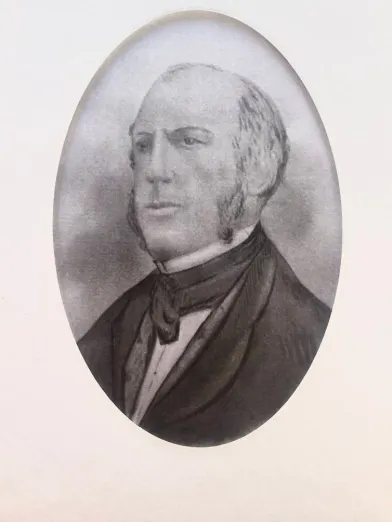
George was educated in England.
George's start. Born in Barbados. His father, Thomas, died when he was a baby. Yellow fever at sea.
The numbers are the baptism numbers allocated to each child baptized in the Barbados at St Michael's Church. Bridgetown. George the last baby. .
- 43U Lucy Elanor 1793, - 44U Margaret Hanah 1796- 45U Ann 1798- 46U Thomas 1799- 47U Thomas Rutherford 1801 (- m.1824, London, Eng., Harriot Crane (ca1798- ) - 48U Katherine 1803- - 49U George Dalrymple 1807- 101
Anne had returned almost immediately with all her children to Great Britain.
After his education, George married Elizabeth Eades) (1809 - 1854) in Staffordshire.

Arrival 1840
PHOTOGRAPHY The photograph of George holds up a look in half profile. George looks to the distance with dignity. (a photographic cultural style) George was a congenial, kind, smiling human being, texts about him report.
* a Sage Journal article about George is available on the internet.
1979
Laura and David Robinson. Me and Aunty Pris. Kairakau Beach. Central Hawkes Bay. 1979 Laura Robinson ( 19012 - 1995 ) David Robinson ( 1944 - ) Stephanie Beth ( 1948 - ) Priscilla Feickert ( 1920 - 1996) Family Archivist

Appendix 1.1 Family

Every Monteith Daughter in their back yard having a tea party on Dixon Street. Lizzie, Lucy, Maria, Kathryn, and Anne-Marie. The 6th person? The cook may have joined them. 1858 Aged Stereograph. By George. D. Monteith. 1858. MTG *
Note Sepia tones images are typical of damage that is caused by non-controlled temperature storage of early photographic material. These are dated 1858, first held in a cardboard box in private care, many years later delivered to the MTG museum as being of interest. *


Return to CHAPTER ONE here if you are reading CHAPTER ONE currently
* A verification letter about the stereographs to Priscilla Feickert from the Dominion Museum that confirms this stereograph is in private collection
My second prompt for the website: Essayist. Novelist. George Eliot. 1819 - 1880 Author of Middlemarch. 1871-72
Bearing in mind, Einstein (1879 - 1955)
Scientist. I pasted a poster up on the wall above the dining table for a couple of months when I started writing notes in 2022. Albert Einstein. (1879 - 1955)
Cousin II, Caroline Genet and daughter, Charm, look over a scrapbook that belonged to Charm's Great grandmother Priscilla Feickert. (1920 - 1996) Photograph by Stephanie Beth. 2022. Caroline's Dutch father arrived to New Zealand on a flight from Holland in 1970. Her mother is Julia.
Ida Lysnar (nee Tiffen) (1886 - 1939) Daughter of Lucy and Fred Tiffen. Wainui Beach. Poverty Bay. c 1896 ( go to CHAPTER TWO)
Seth Tiffen. Elmshill. c 1915. Photograph by Frank Tiffen.
Frederick John Tiffen (1846 - 1911) at his home. Station Street. Napier. c 1903
<< back to Hawkes Bay Tiffen men, if you have been looking at that file
Building one's own bedroom. Young Seth Tiffen with his friend Wallace Atherfeld. Elmshill 1928.
Family. Grandfather Frank Louis Tiffen (1873 - 1938), Priscilla Ruth, Eleanor Beth, Seth John and grandmother Irene Tiffen (nee Bone) with Frank Monteith Tiffen. c 1922
Eleanor (1913 - 1959) and Seth (1908 - 1992) Tiffen , with an adult and a baby.
Elmshill sheep yards. Seth Tiffen and two shepherds, Bob Farrier and Doug Malthess. Elmshill c 1964
<< link back to where you are reading chapter one
Tom Robinson. c 1988. Photographed by his mother Stephanie Beth (nee Tiffen).
CHILDREN
English migrating children. Monteith
Elizabeth and George Monteith’s children were: Maria, George, Lizzie, Jacob, Lucy and Kathryn.Children born in England: Staffordshire Maria b 1830 d 1918 NapierGeorge Dalrymple b. 1833 d 1867 NapierLizzie b. 1835 m 1859 d 1891 Napier Jack (Jacob) b. 1837 d 1884 WellingtonLucy Eleanor b. 1839 m. 1859 d 1910 Napier

MONTEITH DEPARTURE 1839 from Graves ARRIVAL February 8.1840
George had been in a business partnership with an Apothecary in the West Midlands. George closed up shop and bought a ticket out in 1839. Lucy, fifth Monteith child, was six weeks old when she departed London in 1839. The Monteiths arrived at the Petone stream. After leaving being aboard ship, the family loaded into a rowboat and paddled up a small side stream, (the Waiwhetu )stopping soon in the narrow strip of water and marsh flax bushes. (by what is now a golf course, the Shandon).For all settlers to be migrants, the real target focus was food, shelter and viable work. DR MONTEITH FIRST Advertisment for BRITANIA
------------------------- Dr. Monteith S UR G E O N Britannia----------------------- He, with family, slept in the temporary ‘camp site’, Britannia, in Petone when he came in for the first two or three months. The family cleared out of Britannia quickly, for season floods happened there. (There are detailed stories about the Britannia camping city having to evacuate). Noted here: It appeared in all issues of the weekly newspaper New Zealand Gazette & Britannia Spectator during October 1840.City planners noted Spring Tides on the Petone side of the southern shore, after which hasty new plans for a town on the Te Aro side of Nicholson Harbour, (about to be renamed Wellington) took hold. George, at 39 years, bought a section on the Te Aro side of the harbour. He had a house built on Dixon Street where the family remained until both of the parent's deaths. Dr Monteith formally announced in the newspaper that he had relocated his surgical practice to the new settlement.This first incentive he put on hold. There was little sign of medical work being required in a new colony to start with, the population dominantly being strong young able men. Therefore, he ran his own bar on Lambton Quay on Featherston Street for two years, by all accounts, with affability and charm. His first advertisement notified that he had commenced proprietorship of The Freemason’s Hotel. The advertisement appeared in The New Zealand Gazette & Wellington Spectator 8 May 1841. Advertisements for the hotel during Dr Monteith’s management appear regularly in both the Wellington newspapers until mid-February 1843. ---------------------------------------------------------------MEDICINE AND MIGRATION NOTES George D lost his dad to yellow fever, when he was just one. We may ask what traveller from the north coped well in warm latitudes before quinine or penicillin? George’s childhood and education was to live in the Stirling area in England once his widowed mother trooped the seven children back to England. He got to study medicine. He qualified to run an Apothecary with skills taught prior to the Cambridge University system, where learners were with equivalents in England or Glasgow, or in France or Germany. Medical books in England, and later, medical books via the Suez -Canal, did reach their readers. (We do not underestimate the Suez -Canal even today. See the Covid shipping crisis at Suez in 2021) His interest was research. He explored the possible values of ether as a brief resuscitator. There was a high number of Victorian women who could not swim who were drowned in their clothing. There was so much fabric drag even close to shore as rowboats encountered tidal rough waves and tipped passengers out. In Britain, medical expertise was growing in recognition, particularly in metropolises. This article is a useful overview about medicine for physicians. It was written in the Oxford Academic about 1830 in 2020. The author is Bonner. ‘The political revolutions of the old century, which ushered in a long period of turmoil and conflict, had been followed by a period in the early nineteenth century of reaction and consolidation, new industrial growth and the spread of cities, commercial expansion and rising prosperity, and a high degree of political turbulence in every country. No nation escaped the impact of rapid population changes, of buoyant capitalistic enterprise, of the spreading democratic tide, or of the efforts of reformers to help those most adversely affected by the urban-industrial revolution. The training of doctors was inevitably influenced by the rising power of the middle classes in Europe and America as they demanded more medical services and a higher standard of medical competence. The continued growth of industrial cities, notably in Britain, posed serious problems of public health and the medical care of the poor. By 1831, London’s population was already approaching a million and a half, and nearly half the remaining population were now living in towns of more than five thousand. The doctors most in demand in these conditions were those who joined a skill in practical medicine with a knowledge of the new practical sciences. The new studies of science, it was increasingly believed by laypeople, gave the physician a surer command of diagnosis and a better understanding of the disease process, and his practical skills assured the patient of the best possible treatment. Medicine as a practical science, in short, was seen by the public as an important advance over both the old humanistic medicine of the universities and the crude empiricism of the earlier practical schools. The triumph of the clinic and the rise of the new sciences together created a new confidence in medical education. The schools themselves were becoming more alike’. George lived in the country for eight years before even a government had formed. George Grey, (politician) was the first Governor from 1845 - 1853. My father delivered the anecdote to me, that George had a role as the supervisor of the colonial hospital where he attended a great number of meetings with Grey.

>> page Three Appendices 1.1 Family. Arrival
ALL content
home

We use cookies to enable essential functionality on our website, and analyze website traffic. By clicking Accept you consent to our use of cookies. Read about how we use cookies.

Your Cookie Settings

We use cookies to enable essential functionality on our website, and analyze website traffic. Read about how we use cookies.

Cookie Categories
Essential

These cookies are strictly necessary to provide you with services available through our websites. You cannot refuse these cookies without impacting how our websites function. You can block or delete them by changing your browser settings, as described under the heading "Managing cookies" in the Privacy and Cookies Policy.

Analytics

These cookies collect information that is used in aggregate form to help us understand how our websites are being used or how effective our marketing campaigns are.