Appendices. Family: early Settlers
My Family
MEDICINE. MONTEITH FAMILY.
Note. The very early concern of Governor Grey was to vaccinate Māori against smallpox.
see .https://paperspast.natlib.govt.nz/newspapers/
1849
Coroner. George. D. Monteith. 1849. New Zealand
George Monteith was a coroner after his early years as doctor and assistant surgeon/surgeon, in New Zealand.
Here is a delicate speculation on unrequited love in 1849.
A coroner report. G.D. Monteith One media report came in in Nelson. NELSON EXAMINER & NZ CHRONICLE
21 November 1849/ CORONER'S INQUEST.An inquest was held on Saturday at the Victoria Hotel, near the Te Aro barracks, before Dr. Fitzgerald, coroner, on the body of Serjeant Mangin of the 65th regiment, who had shot himself on the previous day. George Dalrymple Monteith, being sworn, wrote
'I am a surgeon, practicing in Wellington; on Friday morning last, the 16th of November, between the hours of 8 and 9 o'clock, a.m, I was sent to see Serjt. Mangin, of the 65th Regt. who was reported to have shot himself; I found him in one of the wards of the military hospital lying on a bed with a gunshot wound on the left breast, extending into the lungs, and a corresponding wound immediately above the left scapula; there was a large escape of blood and air with each expiration; he then told me that he had shot himself, and that he had done it through love; he was in a state of great collapse, from which he never rallied; I have no doubt that this wound was the cause of death.'
LOWER HUTT and WELLINGTON
Cameo of Time
A piece of Lower Hutt history as geology.1848 1848 Severe earthquake. The hospital where Monteith was working topples in the 1848 1854 Christ Church gets built, Taita1855 Earthquake raises and drains Hutt lands.The hospital was in a brick two story in Thorndon. Its second story brick roof toppled in the next big quake of 1855 - the Wairarapa Fault, m 8.2.

Dixon Street. Wellington. By George D Monteith. 1858. (Private collection)
Monteith family christening dates St Michaels on Barbados Island
The Family of (26T) Thomas Monteith and Anne Paget (All baptized at St. Michael, Barbados)The numbers are the baptism numbers allocated to each child. - 43U Lucy Elanor 1793, - 44U Margaret Hanah 1796- 45U Ann 1798- 46U Thomas 1799- 47U Thomas Rutherford 1801 - m.1824, London, Eng., Harriot Crane (ca1798- ) - 48U Katherine 1803-- 49U George Dalrymple 1807-
George D (Dalrymple) Monteith was a baby christened in St Michael Anglican church, on the Barbados island.
His father Thomas had moved out of Scotland into the new trades of the English Eighteenth Century. Thomas was in coffee.
By then, this was the last and seventh Monteith child christened there for the Monteith family from Port Glasgow, Scotland.
The children lost their dad to yellow fever, when baby George was just one. George’s childhood and education was to live in the Stirling area in England once his widowed mother trooped the seven children back to England to be raised and educated.
The Monteith family arrived at the Petone stream, Wellington, unloading off rowboat to tents in Britannica. George bought a section in Te Aro and had a house built. Elizabeth Monteith lived fourteen years in New Zealand until 1854. There is nothing written about her. She completed an embroidery while sailing out to NZ. The subject is of pregnant Mary on a donkey. Walking beside her is a man with a staff, presumably Joseph. (a standard church story tableau). Elizabeth lived in Wellington on Dixon Street, raising six of the children before she died. She is buried with her husband and their second son Jack (Jacob) the pharmacist and the baby of Marie and George Neill (soldier in Imperial service, son of a captain in the Imperial Army. (He died in 1886) in the Bolton Street cemetery. All the Monteith female children married: Lizzie, Maria, Lucy, Kathryn, and Mary Anne. The two sons, George and Jack were bachelors. The married women’s children lived and died in Wellington, Hawkes Bay and Gisborne. Their children, whether farmers or not, spread over Hawkes Bay to Tauranga and Auckland. Major gravesite clusters for the family and descendants are Bolton St. Otane, Napier Hill and Purewa, St John’s Rd, Meadowbank, Auckland. Ongoing generations have been buried in Titirangi and Albany.
George got to study medicine in England. He qualified to run an Apothecary with skills taught prior to the Cambridge University system, where learners were with equivalents in England or Glasgow, or in France or Germany. Medical books in England, and later, medical books via the Suez Canal, did reach their readers. (on from Boston to England, then Australia, then New Zealand) He had established an Apothecary just out of Birmingham in the 1830s with a partner, but the partnership dissolved. (a bankruptcy).
His interest was research. He explored the possible values of ether as a brief resuscitator. He had landed and slept in the temporary ‘camp site’, Britannia, in Petone when he came in for the first two or three months. A high number of Victorian women, none who could swim, were drowned in their clothing. There was so much fabric drag even close to shore as rowboats encountered tidal rough waves and tipped passengers out.
He worked at the Wellington Colonial Hospital. George D’s first hospital work was in a brick two story in Thorndon. - it fell (bricks in an earthquake) in 1855 - the Waiararapa Fault, m 8.2)
Typical for early English arrivees to the colony, George bought farmable land, as well as having a job, and flocked this with sheep. He bought land named Oero. Jacob (Jack), second son, did some shepherding for him on his Oero Block as his first work* To do this, he boarded at Elmshill.
Oero was a piece of the large Edenham block, that was first bought by an Australian owner, later, the Chapmans. (Enjoy Alfred's sketches and water colours if you missed these) (This was on land that was to become Hawkes Bay in 1855. This province was the last province to be established in the country).
Within two decades from 1840, the couple’s son, George, and their daughter Maria, by then a divorcee, moved to 'greener pastures' too. George became a clerk in Napier and Maria a music teacher. Lizzie and Lucy became sheep farmer's wives.
Within two decades from 1840, the couple’s son, George, and their daughter Maria, by then a divorcee, moved to 'greener pastures' too. George became a clerk in Napier and Maria a music teacher. Lizzie and Lucy became sheep farmer's wives.
Nickname Elizabeth Monteith "Lizzie"
*Oero district- (became called Elsthorpe)

George. D. Monteith Jnr. 1833 - 1886 Clerk. Napier. ( Private collection )
George Monteith Senior: his skills, his business and his health
Historically, George D was not a Victorian. Born in 1808, he boarded a barque in 1839. His adult time in England was the in-between time, between Georgian and Victorian. His Monarch had been William 1V. He had benefited from the period in England that had had turmoil of the long 18th Century wars and a period of blooming and busy peace in the early 19th. The population had already reached over a million in Britain. Medical expertise was growing in recognition. A “hard working, conscientious man, “was how the monarch he was under was described. George D died when he had been the Supervisor of the Colonial hospital in Thorndon.
George D made it to age 55 in 1862, his wife Elizabeth to 1856 at age 45. Their last child was just a toddler when Great Great grandma Elizabeth died.
About the use of ether, a first patient needing a tooth pulled, who had it used on him. It was then used on the first patient requiring surgery next. This was for tumour removal. That patient was a Maori chief who recovered well and was a signatory on the Treaty of Waitangi when forms arrived down from Auckland.
An article covers information about early steps in hospitals with Anesthesia *
*A FIFTY-YEAR HISTORY OF THE NEW ZEALAND SOCIETY OF ANAESTHETISTS
'Dr Monteith was popular, gentle and understanding.'
2009
https://journals.sagepub.com/doi/pdf/10.1177/0310057X090370S102
It is noted that George suffered from epilepsy towards the end. That meant he was entered into an asylum in 1862, for there was no known care of the neural condition then.

Manners Street. Wellington. Nat.Lib.

The New Zealand Hotel. c 1850
.jpg@webp "image title")
Jacob Monteith. (1837- 1884.) Pharmacist. Manners St. Wellington.
By the late 1870’s Jacob ran a Pharmacy on Manners Street, Wellington. George guided Jacob into taking on the profession of becoming a chemist. Jack had cardiac arrest on the job at work in his forties.

1864
Maria Neill 1830 - 1913 ( nee Monteith )Composer and Music teacher. (private collection)
Wellington Independent 17th March 1864 page 2 [1]MARRIED.Neill - Monteith - on the 10th March at St John's Church, Napier, N.Z. by the Bishop of Wellington, Deputy Assistant Commissary General G. J. Neill, second son of Capt. Neill, late 85th King's Light Infantry; to Maria, third daughter of the late George Dalrymple Monteith, Esq. Colonial Surgeon of Wellington, N.Z.
Maria and George Neill had a baby, Ava, who died who is buried in the Bolton Street Monteith plot
Maria divorced. She had family support to then own a house in Clive square. Napier. She became a music teacher.
1885
Maria was first family witness to Jacob's heart attack and death. 'His sister Maria rushed, when told, to the chemist shop. Jack had been taken back inside after collapsing in the company of a concerned colleague in the yard behind. ' 1885 Death noticesJacob Monteith; https://paperspast.natlib.govt.nz/newspapers/CHP18840108.2.14https://paperspast.natlib.govt.nz/newspapers/EP18840107.2.20
Maria is mentioned delightfully in a cameo page. This came to me from a Dunedin listing about New Zealand composers. She composed two mazurkas and taught music classes in Wellington. * I only learned of Maria’s musical endeavours in 2023. I saw a photograph of her for the first time, also when more family archives were shown to me then. The compositions listed here were published in Otago in 2019.
Our mazurka. (Wellington: Burrett, 1873)My spirit king. (Wellington: Burrett, 1880)
Concerning love of music, at Jack’s funeral an announcement mentioned how much he had liked playing the cornet, ‘having formally assisted at numerous concerts in Wellington’
I read David Mathew’s biography of Benjamin Britten the other day (published 2003). The publisher quoted Britten on the jacket cover, 1937: ‘It is cruel, you know, that music should be so beautiful. It has the beauty of loneliness & of pain: of strength & freedom. The beauty of disappointment & never- satisfied love. The cruel beauty of nature, and everlasting beauty of monotony.’ I thought, vis a vis my great x 2 Aunt Maria, if I had been close to her age when she died, I would have wished to salute her at her funeral seeing as she composed music. Maria was the one female in the family that I knew of who had experienced domestic violence. The family rallied behind her. She gained a divorce, not an easy step achieved on fair grounds in 1870. My father intimated to me, when I was in my twenties, that Maria had it tough because her first husband was a soldier in the Imperial Army. He had issues with violence. (His duties were mostly in Melbourne) Dad knew this as dad’s granddad had mentioned a concern in a diary. I knew decades earlier that their one baby, Ada Eleanor, who did not live more than a few weeks, was buried in the family grave. I visited Bolton Street Cemetery. The grave has a number. D Number. 105074.
In the cemetery, the gravesite for Richard Seddon, an early premier, stands in white-washed prominence not far above the Monteith plot down the hill. George came into the community at the time when stereography was a thing. A feature for him.
I read David Mathew’s biography of Benjamin Britten the other day (published 2003). The publisher quoted Britten on the jacket cover, 1937: ‘It is cruel, you know, that music should be so beautiful. It has the beauty of loneliness & of pain: of strength & freedom. The beauty of disappointment & never- satisfied love. The cruel beauty of nature, and everlasting beauty of monotony.’ I thought, vis a vis my great x 2 Aunt Maria, if I had been close to her age when she died, I would have wished to salute her at her funeral seeing as she composed music. Maria was the one female in the family that I knew of who had experienced domestic violence. The family rallied behind her. She gained a divorce, not an easy step achieved on fair grounds in 1870. My father intimated to me, when I was in my twenties, that Maria had it tough because her first husband was a soldier in the Imperial Army. He had issues with violence. (His duties were mostly in Melbourne) Dad knew this as dad’s granddad had mentioned a concern in a diary. I knew decades earlier that their one baby, Ada Eleanor, who did not live more than a few weeks, was buried in the family grave. I visited Bolton Street Cemetery. The grave has a number. D Number. 105074.
In the cemetery, the gravesite for Richard Seddon, an early premier, stands in white-washed prominence not far above the Monteith plot down the hill. George came into the community at the time when stereography was a thing. A feature for him.
ReadingBy Dr. Phillip Speer.https://brewminate.com/edward-gibbon-wakefield-on-systematic-victorian-colonization-and-its-discontents/
Sailing
Monteiths 1840. Fred Tiffen 1846
The English Tiffen Children were: Charlotte 1815. 1862 *Henry Stokes 1816 - 1896 ** migrated 1842Amelia 1823 - 1881 (m Wigginton)Mary Elizabeth 1824 - 1856 (m Westgarth)Charles Hart 1826 - 1899 (m Esther Carmilina)Fred John 1828 - 1911 (m. L.E. Monteith. 1859). Ansell 1829 - 1916 - bachelor. migrated 1855Belinda 1836 - 1923. (m Haselden) migrated 1860.
* Charlotte married Theodore Alfred Davenport on 17 March 1843 and moved with him to Boulogne where he was a teacher. She and her husband had six daughters and two sons, though the youngest died aged four. One daughter was Amelia. Note. Charlotte’s daughter, Amelia Randall (nee Davenport) migrated to NZ. 1875 to work for her uncle Henry.) ** (Henry married two White sisters. C and L White 1842 and 1855. London) Migrated to NZ. 1841 with Caroline. They arrived with their baby about to be born in 1842.) Henry in sum below.
* Charlotte married Theodore Alfred Davenport on 17 March 1843 and moved with him to Boulogne where he was a teacher. She and her husband had six daughters and two sons, though the youngest died aged four. One daughter was Amelia. Note. Charlotte’s daughter, Amelia Randall (nee Davenport) migrated to NZ. 1875 to work for her uncle Henry.) ** (Henry married two White sisters. C and L White 1842 and 1855. London) Migrated to NZ. 1841 with Caroline. They arrived with their baby about to be born in 1842.) Henry in sum below.

Duke of Roxburgh. 1840
H and C Tiffen 1842

Illustrations of the two ships that brought Monteiths and Henry and Caroline Tiffen to New Zealand
The Brougham 1842
1845 The Louisa Campbell carried Frederick Tiffen adolescent to New Zealand. He arrived 1846.
1855 more Tiffens
Ansell and Mary Tiffen
Henry and Fred’s sister Mary Elizabeth, sailed to New Zealand in 1855 with her brother, the third Tiffen male Louis Ansell Tiffen.
Mary had fallen in love with the captain of the ship. She and John Westgarth were wed on 3 May 1856 at St Paul’s church in Wellington and honeymooned in Taitai *
* Fred Tiffen attended this wedding.
1856
DEATH IN SHANGHAI
They then sailed on the Westminster to Shanghai. Mary Elizabeth died on 14 September 1856 and where she is buried in Shantung Road cemetery.
THE ARRIVAL OF THE CHAPMAN BROTHERSto the Elsthorpe district on Atua Rd. The Chapman family then linked to the Monteiths as Lizzie Monteith married Alfred Chapman in 1859. Her sister Lucy married Fred Tiffen who had bought land to farm next door to Edenham. Luct and Fred also married in 1859.
.JPG@webp "image title")
Mary-Anne married David Souter Hunter.https://www.geni.com/people/David-Hunter/6000000035974464847Kathryn Matilda married Mr Warren.https://www.findagrave.com/memorial/158407731/katherine_matilda-warren
Plymouth. England

The Chapman brothers, Frederick and Alfred, sailed out in a barque in 1852. They were sons of Reverend William Emerson Chapman, vicar of Edenham, Lincolnshire. * Ref. National Library.NZ and sketch books held at MTG, Napier
Their father assisted in buying land the brothers called Edenham.
Sailing out on route they venture into the Porto Preya on the island of St Jago
Pen drawings by Alfred Chapman. Diary. MTG.
The men moved up the North Island East coast from Wellington to
farmland before Hawkes Bay was called Hawkes Bay. They established a place that they named Edenham on Atua Rd.
Soon, next door, the farm Elmshill, beside Edenham, bought by Frederick John Tiffen, would begin.
.jpg@webp "image title")


Note. Search. Billy tea or 'Backyard tea party'. A stereograph from 1858. Dixon Street, Wellington.

Cottage Interior. Who is the visitor?


Harakeke. on Eveleyn Couzins Avenue. Christchurch at the beginning of the landscaping for the
te-ara-trail.
https://www.ccc.govt.nz/parks-and-gardens/explore-parks/waterways/avon-river/te-ara-trail
Phormium tenax (harakeke)
J.R.Forst & G.Forst was described in 1776 by Johann Reinhold Forster and Georg Forster, who were the father and son team of German botanists on the second voyage of James Cook.

Hythe. Kent. UK. c 2025. Online image
TIFFENS LATE 1700s . HYTHE. KENT
1842
TIFFEN ARRIVAL NEW ZEALAND
The first Tiffen to arrive from England was the eldest son, Henry. Henry Tiffen (1818 - 1896) migrated to Wellington in (1842) with his young wife Caroline. His job was assistant surveyor for the New Zealand Company.
He was, upon arrival, age twenty- five, whilst Frederick came out upon request by Henry, as soon as he turned sixteen in 1846.
Tragically, Henry's child and Caroline died no more than two weeks upon their arrival.
Second Tiffen to arrive. Fred John
Third and fourth Ansell and Mary Elizabeth.
Fifth. Belinda with husband
Amelia Tiffen (1823 - 1881)
Private Collection
Amelia, seven years younger than Henry and twelve years younger than her first and eldest sister, was born in and lived in England all of her life.
.jpg@webp "image title")
correction. Amelia 1823 - 1881
.JPG@webp "image title")
Frederick John Tiffen (1828 - 1911)
Elmshill Station. 1859 -1879; 1879 - 1998. Elmshill drain. Dug. 1890 Fred bought acreage to become a farm in 1859. He spotted the hills and the basin when he visited his sister in law’s husband to be, in residence on Edenham Station, Elsthorpe. Edenham was the next farm south over a ridge of hills. This is where my family lived the first twenty years. Lucy and Frederick married in 1859 when Lucy was nineteen and Fred twentyfive. They married in Wellington, with breakfast afterwards at Dixon Street, Wellington, at George and Elizabeth’s home. Fred had set off in Louisa Campbell in 1845 as an adolescent, as soon as he had finished high school in England. He had done so upon his older brother’s bidding. Henry , twelve years his elder, had a job as an assistant surveyor and had quickly viewed the lay of the land for the sheep industry. He had come out in 1842. The sheep that Fred first worked with had been bought in Sydney - a large flock of pregnant ewes. In those days, heavy loads were carried by bullocks. All other transport was by horse or by coastal steam shipping. Fred worked for his brother at the outset. After the task for his brother ended, he was manager for an absent owner’s estate called Guavas, Hawkes Bay. It was then that he became engaged to Lucy. He had been several times down to Wellington on business. Also, Lucy’ s father owned and then sold the Elsthorpe area, then called Oere, so was up that way, on one of the visits bringing young Lucy for company. In senior life Fred became a government sheep inspector. Fred made other observations and important family experiences. He also fitted in rare experiences. For example, he trekked by horse, went out in an assisting walk, and saw the Pink and White Terraces before they disappeared.
Frederick farmed his property in Central Hawkes Bay from 1859 to 1890, moved to Napier in 1978. remaining in a supporting role to his son Frank Louis by correspondence and making visits to Frank’s bachelor world. Many work related letters were exchanged between the two. He built a house for his family in Napier after he retired from Elmshill. This was a slow build of a large wooden home on Station Street with an intricacy of features. The house survived the Napier earthquake of 1931. It became a private hotel for quite a while after the sale was made by his last daughter Louisa Winifred.
Frank took on responsibility for Elmshill. He ran the place as a sheep and cattle farm. First the stock was Lincoln sheep and Short horn cattle, later, Romney sheep and Aberdeen Angus cattle. The estate continued to be managed under Seth Tiffen. It was divided by the next generation. Anthony Tiffen and his wife Sara, ran a private farm of one portion there , living in the homestead until 1998. Fred entries in his diary include his notices about the activities of his adult children spread over the North Island.
Frank took on responsibility for Elmshill. He ran the place as a sheep and cattle farm. First the stock was Lincoln sheep and Short horn cattle, later, Romney sheep and Aberdeen Angus cattle. The estate continued to be managed under Seth Tiffen. It was divided by the next generation. Anthony Tiffen and his wife Sara, ran a private farm of one portion there , living in the homestead until 1998. Fred entries in his diary include his notices about the activities of his adult children spread over the North Island.
New Zealand. 1866
.jpg@webp "image title")
Ida Tiffen (1866 - 1939). Parents Fred and Lucy Tiffen. New Zealand. Private collection.
LATE 1700s
Tiffen senior. England.(George)William Tiffen 785- 1855Charlotte (Stoakes) 1771 - 1876
in Folkestone, Kent, Charlotte married William Tiffen.
William Tiffen had converted from non -denominational to Anglican. .Tiffen a printer and binder. Bookseller, High st.In his later life he opened a library and reading room (1845), “as the railway had reached the town which was now easily accessible to cross-channel travelers and holiday-makers.”
He died in 1855.
Charlotte died in 1876 at 84.
William was born in Bocking, Essex, on 10 January 1785, the son of a miller. At the age of twelve, he was apprenticed to a printer, John Shearcroft in his hometown but had moved to Kent by 1809 when he married Sarah Stevenson in Folkestone. He then set up shop as a printer in Hythe catering mostly for the military, but as they started to leave the area he moved to new premises in 1813 and diversified. In a shop with living accommodation on the corner of Mount Street and the High Street ‘nearly facing the Guildhall’ (it was later gutted by fire and demolished) he became ‘bookseller, stationer, printer and bookbinder’ Then he set up a lending library and a Reading Society, of which he was president.
They had eight children - he had one son before (William) with first wife who died. (William died 1837) William senior was baptized Anglican, was an overseer of the poor and a church warden.
Their Eight children.Charlotte, Henry, Mary, Amelia, Frederick, Charles, Ansell, Belinda
Daughter Charlotte (born in Hythe on 5 January 1815) married Theodore Alfred Davenport on 17 March 1843, and moved with him to Boulogne, where he taught. She and her husband had six daughters and two sons, though the younger died aged four. Charlotte and Theodore both died in Boulogne, she in 1862, he in 1869.
Charles Hart Tiffen, born in Hythe in 1826, did not get as far as New Zealand. He spent much of his adult life on the continent. His wife, Esther Carmelina, was born in Italy; their three daughters and a son came into the world in Nice. Charles operated for a time as a wine merchant in Brighton, where one daughter died, but the family were in Folkestone from about 1889, where they lived in Guildhall Street. One daughter, Esther (or Mlle. Esther Tiffen as she advertised herself), gave lessons in French and Italian; the other, Helen, taught violin, viola, organ and pianoforte. At their father’s funeral, they were joined by their brother, William Henry Tiffen, who had also been born in France but decided to stay there. He ran a successful removals company in Paris in partnership with James Arthur, a company which still exists today.
Henry Stokes Tiffen 1816 - 1896
Henry, born Hythe, Kent, was hired by the New Zealand Company as an assistant surveyor. He leased land off Maori. Later, he bought land and sheep. Henry married both White sisters from Hastings, East Sussex Caroline and Louise. Caroline tragically died upon arriving in NZ at age seventeen.
Parents: Captain Mark White, (Royal Navy)Broomgrove, Hastings, East Suffolk and Ann nee Foster.Henry in lodgings with the White family.
Caroline.He met the Whites in 1839 or so. Stayed at the house of Captain Mark White R.N. and Anne White. in early ‘41. (British census 1841) He met Caroline Helen at 15. Naval & Military Gazette and Weekly Chronicle of the United Service 13 April 1844.
He married 16 -year- old Caroline two days later, “Sept. 29, at Oare (ora) church, Sussex
Mr. H.S. Tiffen, of the surveying staff proceeding to New Zealand, eldest son of Mr. Tiffen, library, Hythe, to Caroline Ellen, youngest daughter of Captain Mark White, R.N., of Broomgrove, Hastings”. White had been a midshipman on the Bellerophon and was listed among the “surviving heroes of Trafalgar”. He was promoted to Commander in 1827. On 27 September 1841, Henry signed a contract with the New Zealand Company to work as an assistant surveyor; three days later he married the younger White daughter, sixteen-year-old Caroline and three days after that the newly-weds sailed on board the Brougham to New Zealand.
Page 328. Marriage of Caroline to H.S. Tiffen. 1841.1841. March. Marriage, at Ore Church, Sussex, Mr. H. S. Tiffen, of the surveying staff proceeding to New Zealand, to Caroline Helen, youngest daughter of Capt Mark White, R.N. of Broomgrove, Hastings. Sussex
To New Zealand 106 daysThe ship, Brougham set off down the river then sheltered inshore for three weeks to wait for a storm to subside.
Tiffen, along with cats, benefitted from one worried mother:
'The voyage began badly. Strong headwinds and then a heavy gale compelled them to put into Cowes, where they lay wind bound for three weeks. The young gentlemen had of course suffered more or less from mal-de-mer, but we suffered more from insufficient accommodation, lack of proper attendance and food. I had written some account of our condition and our experiences in the Channel to my mother... Horrified at the state of matters on board my mother hurried to Mr Wakefield with my letter. At a subsequent meeting of the Board of Directors my mother was authorized to proceed to Cowes, with carte-blanche to remedy all evils and put us in a proper position to proceed to sea. In a few days a marvelous change was effected—Carpenters were employed to improve our sleeping berths—a second servant was engaged for the cadets—large quantities of poultry and other provisions were put on board—and many comforts suitable for a long sea Voyage were supplied for our use.' * Henry.
Brougham reached Port Nicholson on 9 February 1842 after 106 days.
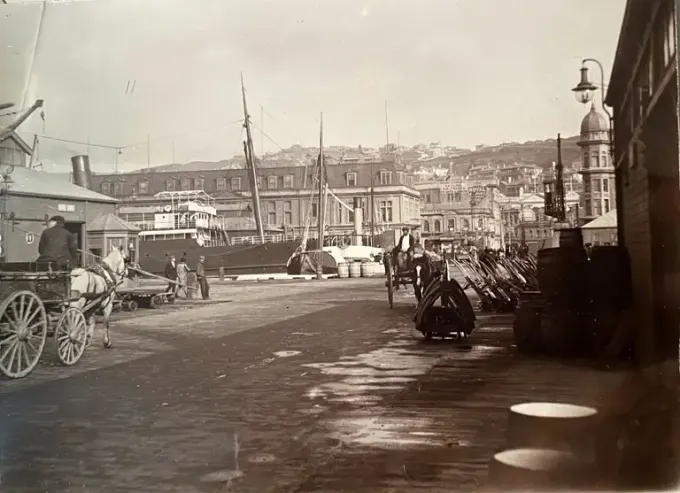
Wellington Harbour. 1842 - 1880Wellington ships. https://images.app.goo.gl/zogY5HdyKkMwaKfH7
Caroline died with a stillborn son in Wellington in 1842
1841. London. P 77In addition, General news, same publication. 1841P 77 Announces Bishop G.A. Selwyn MA. to be Governor of New Zealand. Also note, there is a feature article on the man who established Dulwich school for boys in the 1500s in London.
In 1855, Henry left the station in Frederick’s hands and returned to England. He stayed there for some months. He married the elder White sister, Louisa, when she was 28. Their marriage ran until her death in 1875.
1856He secured an appointment as a Wellington provincial surveyor. From October 1856 he was in control of the Napier land office and all surveying in the district, responsibilities which he continued to bear as commissioner of Crown lands and chief provincial surveyor after the separation of Hawke's Bay province in 1858.
Surveyors from 1840https://www.surveyspatialnz.org/Attachment?Action=Download&Attachment_id=2653
* Cited by Ian St George. A writer who chronicled several 19th Century New Zealand colonial men. https://onadmiralroad.co.nz/henry-stokes-tiffen/
** ditto